



Sep 17 2026
Cloud

The Minnesota Wild Score Big With a Phone and Contact Center Upgrade

The NHL team replaces an aging, on-premises system with a modern, cloud-based solution that improves customer service and the employee experience.

Because hockey teams can change lines on the fly during games, swapping in fresh players without stopping play, the Minnesota Wild’s IT department decided to follow suit during a much-needed upgrade.

Last year, the NHL team switched from an aging, on-premises phone system and contact center to Zoom’s cloud-based solution without disrupting communications. The Wild wanted to modernize — not just update — a decade-old system so ticket sales and service staff could have an agile contact center with smarter call routing, a centralized user interface, better portability and automatic call transcriptions powered by artificial intelligence.

The previous system required a lot of coding and scripting, which made it nearly impossible to make even small modifications. So, the Wild decided to migrate to a cloud-based solution to improve customer service and operational efficiency, says Senior Director of IT Josh Kielbasa. 

“We needed to modernize the contact center to something that lived in the cloud, something that wasn't 10 or 12 years old that needed constant updates and something that was easier to manage,” he says. 

Click the banner below to discover a winning strategy to improve staff and fan experiences.


The Wild’s first call was to CDW, which provided product demonstrations, recommendations and implementation services. For Kielbasa, CDW is a longtime, trusted partner whose engineers deployed the existing IP phone system and contact center in 2015, and through its managed services, provided day-to-day management and troubleshooting. 

“CDW has been our go-to. They advised us on what they think we should do,” Kielbasa says. “We narrowed our list down to three or four candidates, and then they walked us through the demo process straight into the implementation process. They were with us the whole way.” 

Why the Minnesota Wild Chose To Move to the Cloud

Some companies still prefer on-premises solutions, but many are increasingly adopting cloud-based contact center solutions because they deliver needed features, are simpler to manage and use, and in certain use cases, can be more cost-effective, CDW engineers say. 

“For the majority of our customers like the Minnesota Wild, it makes sense to go to cloud. They don’t necessarily have someone dedicated to managing the contact center and voice,” says Mike Fuller, principal consulting engineer at CDW.

READ MORE: How can you optimize your hybrid cloud environment?

In 2024, the Wild began shopping for a cloud-based solution because the three-year software license for its legacy phone system with an integrated contact center was up for renewal. 

The franchise provides phone service for about 500 users at corporate headquarters and three adjacent downtown venues that it manages: the Grand Casino Arena in St. Paul, Minn., where the team plays, and the Saint Paul RiverCentre, which includes the Roy Wilkins Auditorium.

Kielbasa allowed the Wild’s 25-person sales and service team to define the requirements they needed in a contact center, so they effectively drove the decision on a new solution, he says. 

“Last time we did this, we gave them a product and said, ‘Here’s your contact center.’ This time, we wanted to make sure they got exactly what they wanted,” Kielbasa says. “We let them drive the ship, and then we’d fill in the blanks about what we wanted from a phone system.” 
Josh Kielbasa


Erica McKenzie, the Wild’s vice president of ticket sales and service, had many items on her wish list, including smarter call handling so fans wouldn’t be on hold for an hour. She also wanted seamless software-based technology, so ticket sales representatives would have the ability to handle calls outside the office. 

“Technology is always evolving, and we knew we needed a change to do more things that are better for the customer and better for the sales and service team,” McKenzie says. 

The previous system ran on eight servers and was frustratingly complicated. To onboard or offboard users, the old system required CDW’s managed services to make changes in five locations, including the phone and voice mail system. The Wild’s IT team couldn’t do it themselves. 

When the Wild’s IT leaders called CDW Senior Client Executive Amer Harb about a new system, they told him they wanted a Software as a Service solution, so he provided product demonstrations. 

“They wanted to be completely out of the phone business,” Harb says. “They wanted something easier for their adds, moves and changes.” 

In 2024, the Wild tested multiple vendors and considered separate phone and contact center solutions. In 2025, they standardized on Zoom Phone and Zoom Contact Center. 

“Zoom was just a better product for us. It’s all in one, a one-stop shop for management,” Kielbasa says. “Zoom just made it easier from both a logistical and user perspective.”

Data Point


How CDW Supported a Smooth Implementation

With CDW leading the Zoom migration, the Wild asked specifically for the two CDW engineers — known as “the Mikes” — who had deployed the team’s previous on-premises system and had assisted with phone support for the past decade: Fuller and Principal Consulting Engineer Mike Underwood. 

“They’re local, and they’re great,” Kielbasa says. “They’ve implemented about every phone system on the planet, so when we came around to do another phone system, it was a no-brainer. We asked for them by name.”

Fuller says they see themselves as an extension of the Wild IT department, and if a phone issue comes up even in the middle of a hockey game, they will troubleshoot immediately. 

To implement Zoom Phone, the CDW engineers first exported data from the legacy system, including users and their phone numbers. Then, they sat with the Wild’s IT team to update the numbers and figure out which were active and which should be retired.

WATCH: Find out how Cisco’s latest offerings are improving observability in the agentic era.

Once the data was clean, the Mikes configured a Zoom tenant, created Zoom user accounts and tied users to their existing phone numbers. They integrated Zoom to Active Directory, which synced Zoom with users and licenses. They also configured auto attendants and call flows. 

With Zoom, most employees can use the app on their laptops or smartphones, but for those who still needed desk phones, the Wild purchased new Poly IP units because the team’s existing phones were incompatible with the new solution. CDW, which recommended the new phones, could have found a way to make the old phones work, “but it would add too much risk and complexity to the project,” says Underwood. 

The Wild also needed to integrate about 300 analog phones, most of them in the arena, including the penalty box, the concessionaires, door call buttons for delivery and fax machines. 

Through CDW’s recommendation, the team replaced the previous phone system’s analog gateways with new Grandstream Networks analog gateways, which support Zoom.

Click the banner below to learn how to modernize your contact center.

The Mikes and the Wild’s five-person IT staff deployed the gateways and desk phones together. “For three days, we replaced phones and set everything up,” Kielbasa says. 

Through strategic partnerships, the Wild built a new contact center, now integrated with the team’s Salesforce customer relationship management (CRM) tool so that ticket and sales staff could use one application to access customer information and take calls. “There were a few bumps when we were integrating Salesforce. CDW helped us through that process,” Kielbasa says. 

The Wild went live with Zoom in summer 2025, and the cutover was smooth, with no downtime. The Mikes and the Wild’s IT staff worked out of a conference room on cutover day. They ported the phone numbers from the existing carrier into Zoom, and almost immediately, the Zoom phone system and contact center took over. 

Afterward, the Wild IT staff and CDW engineers fanned out across the arena, team headquarters and other facilities to make sure everything worked properly. CDW had fully tested and validated the Zoom configuration to make sure the cutover was seamless. 

“Quite honestly, there weren’t a whole lot of changes we had to make after going live because everything was spot on,” Fuller says. “It was a painless cutover, all things considered.”

GO DEEPER: Why is customer service the focus of most digital transformation projects?

The Minnesota Wild Take the Lead With Zoom

The hockey team’s corporate leaders say the Zoom phone system and call center is everything they hoped for. 

For everyday users, Zoom Workplace became the primary application for phone services, voice mail, contact lists and faxes, Kielbasa says. Another huge benefit is mobility and the ability for employees to easily access their work phone or contact center on their mobile devices, he adds. 

Staff who now work from home on snow days no longer have to futz with an old softphone app, VPN and the sometimes-flaky connections that resulted. 

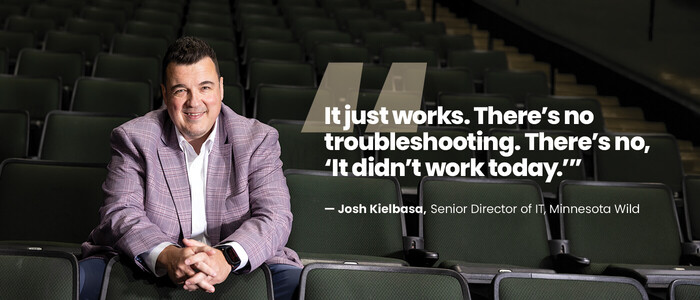
“The biggest thing for users is the application’s simplicity,” Kielbasa says. “It just works. There’s no troubleshooting. There’s no, ‘It didn’t work today.’”

Erica McKenzie


For the Wild’s ticket sales and service staff, Salesforce became the main workspace with Zoom Contact Center woven into the user interface. McKenzie says the new contact center allows staff to work faster and more efficiently, while improving the customer experience for fans. 

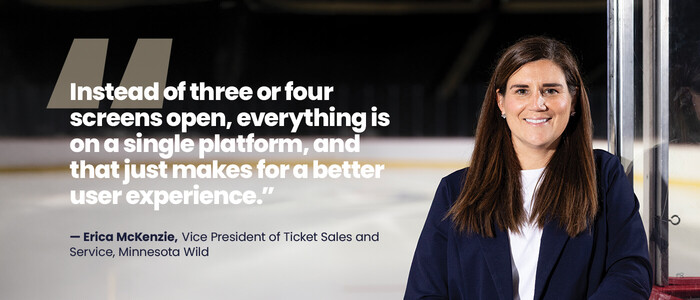
“Instead of three or four screens open, everything is on a single platform, and that just makes for a better user experience,” McKenzie says. 

Zoom Contact Center transcribes calls in real time and is stored on the CRM, which provides representatives an interaction history, she says. Zoom also delivers voice mail transcriptions over email.

Furthermore, supervisors and staff now have central visibility into who’s logged in so they can route calls accordingly. That eliminates blind transfers to people who are away at lunch, she says. The new contact center also eliminates long waits. If a caller has been in the queue for about five minutes, the system allows them to ask for a callback. 

It also offers smarter call routing. If a fan calls the service team and all service staff are busy, the call is sent to group sales or membership so the fan can still get help, she says.

Staff can also record custom greetings during holidays or days when the office is closed. Previously, when no one was in the office — for example, on a Sunday — customers were simply told they were next in line, McKenzie says.

In the future, the staff may take advantage of advanced analytics and other features, but in the meantime, the new contact center has been great, she says.

“It’s been a good experience for both us and the customers. We’re super happy,” she says.

UP NEXT: How can businesses optimize their networks for modern work today?

From an IT perspective, management is much easier. The Wild no longer have to buy and maintain servers for a phone and contact center system, which reduces costs.

The team could not have completed the project without CDW, Kielbasa adds.

“The Mikes are gold stars. They’ve come through for us multiple times. Amer has come through for us multiple times on projects,” he says. “Because of them, it’s a no-brainer that we would pick CDW again and again.”

Photography by Ackerman Gruber
Close

New Research from CDW Explores AI and Cybersecurity

Learn how AI is helping IT teams manage risk and improve resilience.