



Aug 03 2026
Cloud

Accelerating Growth With Cloud Platforms in Finance

Firms are achieving measurable customer service gains, and the revenue boosts that follow, with the right cloud-based solutions.

A few years ago, Members 1st Federal Credit Union found itself at an inflection point. Established in 1950 in Mechanicsburg, Pa., the member-owned nonprofit had expanded to include nearly 60 branches and 625,000 account holders. With high member satisfaction and a stellar reputation, the organization’s rapid growth was naturally introducing new complexity in how it managed and used data.

One of its biggest opportunities was determining how to use data more strategically, says Anita McAllister, the institution’s vice president of data and analytics. “We were in a place that many growing organizations can relate to,” she says. “We had no shortage of data, but we saw an opportunity to build stronger alignment and shared confidence in how we use it to drive decisions.”

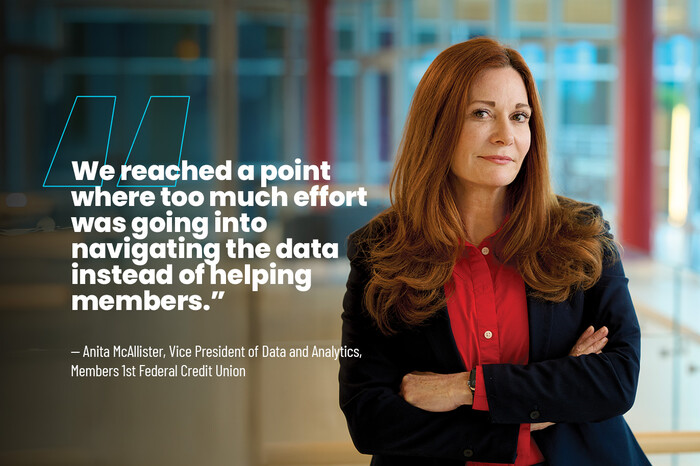
Different managers would look for answers to the same problems using different data from different systems, McAllister recalls. They’d hold a meeting to discuss next steps, and those in the room would inevitably become frustrated by the uncertainty and slow pace of decision-making. “We reached a point where too much effort was going into navigating the data instead of helping members,” she says, explaining how years of growth had led to data being spread across silos built for individual products and channels.

The credit union decided to transition to the cloud, not to follow technology trends but to act as responsible stewards of members’ data. “Moving to the cloud was about creating a secure, scalable environment that supports growth while upholding our commitment to integrity and member trust,” McAllister explains. “Our goal was to enable sustainable progress without sacrificing quality or transparency.”

Click the banner below to explore the right cloud environment for your organization.


How To Get a Holistic View of Customer Data

At the time, the Members 1st team was early in its cloud journey. As a longtime Microsoft customer, the credit union chose Azure as a natural foundation for its next chapter. Partnering with a third-party consultant, it successfully centralized data from more than 15 systems into a cloud-native data lakehouse that it called M1-360.

M1-360 was designed not just to centralize data but also to govern it, establishing shared definitions, lineage and confidence. On top of that foundation, Members 1st enabled modern analytics and reporting experiences through Microsoft Fabric, making insights more accessible across the organization.

“We now have a unified, governed environment,” McAllister explains. “And critically, we also get context, which is everything when you are serving real people making real financial decisions.”

That foundation has begun to change how teams work. Insights generated in M1-360 now inform frontline systems such as Salesforce, giving service representatives a clearer picture of how members engage across products and channels over time. Confidence in data has improved as well. “We know what data is trusted, what is still being refined, and what is ready to support member-focused decisions,” McAllister says.
How OneUnited Bank Improved Customer Service

It was the need for AI functionality, in fact, that led OneUnited Bank to ramp up its use of Google Cloud. With its headquarters in Boston and branches in Miami and Los Angeles, OneUnited is one of the largest Black-owned banks in the country. Over the past two decades, it has also emerged as a leader in digital banking, and with that success, its customer base has expanded significantly.

The bank’s cloud “turning point” came during the unrest in 2020 in Minneapolis following the death of George Floyd, according to James Slocum, OneUnited’s senior vice president and CIO. The bank’s customer service team suddenly found it couldn’t keep up with the volume of calls, “and we couldn’t just hire more people, because we were in the middle of COVID,” he explains.

While OneUnited had previous experience with Google solutions, its technology stack at the time was still mostly on-premises. To resolve its customer service issues, Slocum and his team swapped out their legacy phone system for Google Cloud’s Contact Center AI, “and that was our first major step into their ecosystem,” he says.

CCAI, which the bank still uses today, includes conversational AI agents that interpret customer intent to better route callers to human representatives. Like Fabric, it integrates with Salesforce, giving the contact center team a 360-degree view of every customer interaction.

Slocum estimates that moving to the new system has led to a 33% increase in efficiency. “And it’s not only reshaped our approach to customer support,” he notes, “it’s also pushed us to invest in cloud and AI solutions for other parts of our workflow.”

Using Google’s Apigee API management tool, for example, OneUnited can now easily move banking data from older back-end systems into its customer-facing mobile app. It’s leveraging Gemini for risk assessment in customer dispute cases and to identify possible cases of fraud, and it recently used the AI assistant to build a digital financial wellness tool with conversational capabilities.

“The biggest thing that’s changed since we moved to Google Cloud is our infrastructure is easier to manage and scale,” Slocum says. “We’re in a place where we have better control over everything, and that means we can innovate more effectively and faster.”

Anita McAllister, Members 1st FCU


How Puritan Life Drove Soaring Sales

As one of the industry’s only all-cloud carriers, with all of its systems hosted in Azure, Puritan Life Insurance was uniquely situated in late 2020 to flip the script on its standard approach to selling annuities. Typically, insurance agents work the phones and meet with potential customers in their homes, says Megan Duty, senior vice president of technology.

This had resulted in sizable premiums annually, but with digital modernization top of mind, they knew there had to be a way to increase their reach.

“We had this really well-established cloud infrastructure, so that’s where we decided to start,” she recalls.

Before long, Duty and her IT team of four, working with the tools they had available in Azure, “launched a direct-to-consumer digital distribution channel in a space where none had existed before,” she says.

Canvas Insurance allows customers to independently purchase an annuity online in just a few minutes. Its platform includes educational materials explaining the benefits of various products, and customers can use tools to calculate future earnings based on credit rates and other factors.

Within a year of its launch, Canvas was already outperforming Puritan’s agent distribution, and by 2025, it delivered about 75% of the company’s $400 million in annual premiums.

Duty says there’s no way Puritan’s Canvas project would have succeeded if the company didn’t have the cloud resources that it does. With Azure, she notes, security is built in, taking some of the pressure off her small team, and they’ve been able to “plug in” with solutions like Docusign and LexisNexis to handle everything from legal agreements to payment processing.

“We’re just leaning into what Microsoft offers,” she says. “That’s made all the difference.”

Gene Smirnov
Close

New Research from CDW Explores AI and Cybersecurity

Learn how AI is helping IT teams manage risk and improve resilience.