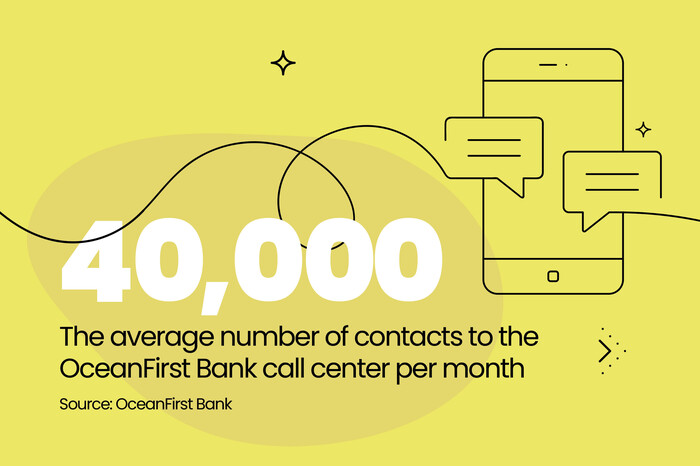
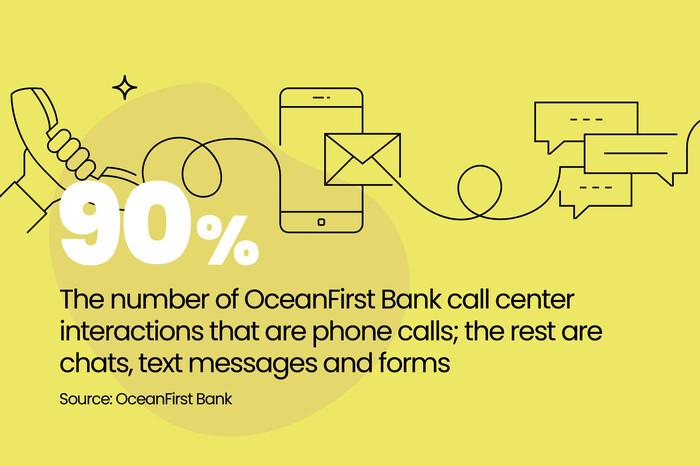
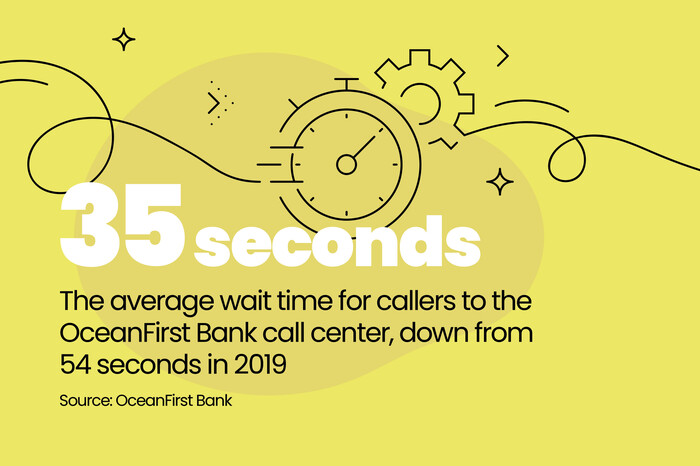
OceanFirst Bank once faced a common customer service challenge: ensuring that customers with complex needs reached call center agents with the right expertise. The bank’s legacy, on-premises contact center always routed calls to the next available agent, regardless of what customers needed help with.
For example, customers with questions about modifying loans or increasing debit card spending limits might randomly reach newly hired agents better suited for routine requests instead of seasoned experts.
In December 2020, OceanFirst implemented Five9’s cloud-based contact center with intelligent routing, ensuring calls reach appropriately skilled agents. And in the ensuing years, the Toms River, N.J.-based regional bank has adopted even more capabilities to enhance the customer and agent experience.
Click the banner to sign up for our newsletter and receive more business IT insights.
“Before, having new agents and more experienced agents take the same level of complexity in calls was troublesome,” says Mallorie Murphy, OceanFirst’s vice president and digital engagement operations manager. “So, that was one of our biggest needs: being able to leverage skills-based routing and make sure calls go to the right agents trained to assist with those calls.”
Financial institutions are increasingly modernizing their call centers with cloud-based platforms to improve customer service and operational efficiency while also empowering agents to be more effective.
These Communications Platform as a Service solutions enable omnichannel communications that include voice, chat and text messaging and provide AI-driven support with real-time agent assistance and analytics to measure customer service performance.
EXPLORE: Elevate the digital experience for your customers.
“They deliver an enhanced customer experience, faster routing, reduced wait times, consistent service across channels, workforce management and personalization because you’re capturing a lot of behavioral data,” says Forrester analyst Kate Leggett.
The shift from on-premises to cloud-based contact centers accelerated during the pandemic as organizations enabled remote work, she says.
More recently, generative AI capabilities have driven further adoption, including automatic call transcription and the emergence of human-sounding, conversational AI agents, says IDC analyst Michelle Morgan.
“These agents can handle common tasks like, ‘I lost my credit card. I need to change my PIN,’” she says. “As things get more complex, they immediately route the call to a human agent.”
OceanFirst Bank Saw Benefits From Its Modern Call Center
OceanFirst Bank upgraded its call center with Five9’s cloud solution because it had outgrown its on-premises system after acquiring more than a half-dozen banks across the Northeast.
“We had different needs as the bank grew and the contact center got bigger,” says Kevin Sweeney, vice president and business analyst in operations. “Beyond skills-based routing, the bank had limited visibility with metrics. We wanted to get into forecasting, workplace scheduling tools and automation.”
Besides skills-based routing, the most significant improvement came from seamless integration with the bank’s Salesforce customer relationship management (CRM) software, Murphy says. Agents previously lacked customer visibility. Now, customer information automatically pops up on the screen showing account details and interaction history.
“It helps agents onboard customers even quicker,” she says.
In the upgrade, CIO Brian Schaeffer replaced the bank’s on-premises VoIP phone switch with cloud-based infrastructure and standardized on Microsoft Teams for voice. That eliminated desk phones and enabled remote work using softphones. OceanFirst integrated Five9 into Salesforce using a Five9 Salesforce adapter and connected Teams via application programming interfaces, enabling centralized call center operations within a Salesforce user experience.
“When our agents are on the phone, they don’t have to worry about opening or clicking on different apps. They have the data they need to solve the customer’s problem,” Schaeffer says. “There are a lot of efficiency gains and time saved.”
Five9’s Agent Assist transcribes calls in real time and provides guidance with recommended actions. After calls end, AI summarizes conversations and stores information within customers’ CRM records, eliminating manual note-taking.
“It allows agents to focus on customers rather than jotting down notes,” Murphy says.
The bank now offers an omnichannel experience, including chat, text and video, all handled by its 45 human call center agents.
In 2025, the bank launched a conversational chatbot from a specialized AI company for chat and voice interactions to resolve routine inquiries, routing more complex issues to human agents.
Overall, the new cloud contact center has significantly improved call center operations, Sweeney says.
“From an automation standpoint, we gained a lot of efficiencies,” he says.
Click the banner below to explore the solutions you need to give everyone a seat at the table.
How John Hancock Upgraded Its Call Center in Phases
John Hancock modernized its call center operations with Amazon Web Services’ Amazon Connect in phases. Its success prompted parent company Manulife to deploy the technology globally, completing the project in 2024.
It was a six-year journey that began with a proof of concept for John Hancock’s group annuities business. With each positive outcome, it was expanded across John Hancock’s other businesses, including life insurance, retail annuities and long-term care.
“Our goal was to modernize our telephony platform and create a consistent, high-quality customer experience across all global contact centers,” says Kartik Sakthivel, CIO at John Hancock.
First, the company replaced its legacy phone system with Amazon Connect and integrated it with its Salesforce CRM software and other systems. The company has also enabled omnichannel interactions, allowing customers to choose how they want to interact, whether by phone, chat, virtual assistant, website or app.
Get a Unified View of Customer Data
The new technology required agent retraining on tools such as the Amazon softphone. But now, agents have a single, integrated view of customer data through Salesforce and other connected systems, Sakthivel says.
John Hancock will continue investing in advanced AI capabilities. It is deploying smarter virtual assistants for deeper self-service. “Our approach promotes digital engagement while ensuring a seamless transition to live support for more complex inquiries,” he says.
The company is also piloting features that anticipate customer needs, predicting reasons for contact and highlighting sentiment from prior interactions, Sakthivel says: “This approach reflects our broader global customer care strategy: providing seamless, intuitive tools that reduce friction, improve operational efficiency, and create better experiences for customers and colleagues.”