



Oct 26 2026
Digital Workspace

Modern Contact Centers Drive Customer Satisfaction by Unifying Data

The problem of fragmented customer information that’s spread across disparate platforms has been solved.

Few things are worse for a customer service representative than coming into a call totally blind. When you lack basic details about your customer — who they are, their transactions, how they’ve interacted with your business — your chances of optimizing their experience with exceptional support are low. 

Not long ago, that lack of visibility was a recurring problem for the customer service team at We Insure, an Austin, Texas-based insurance agency franchisor. With its 26-state network of more than 150 independent locations, the company’s contact center is a shared service organization that works in support of individual customers. 

We Insure’s challenge, explains Joe Kurtz, executive vice president of operations, was that customer information was spread across different systems, which made it difficult to access. “When someone called in, almost nothing was readily available,” he recalls. “The representative had to reconstruct the whole relationship from scratch, on the call.” At the time, the company’s goal was to answer 80% of calls in 60 seconds or less, Kurtz says, but “the platform wasn’t letting us get there consistently, and our franchise owners deserve better than that.” 

An early adopter of Amazon Web Services’ Amazon Connect contact center technology, the company had used the cloud platform for years but had not yet linked it to its other enterprise systems. Kurtz had identified the integration gap as the root of the problem, and in 2025, We Insure engaged Mission Cloud, a CDW company, to close it. 

Click the banner below to unlock insights to modernize your workplace. 


The work was completed in early 2026. Now, We Insure’s optimized Amazon Connect environment is connected not only to its customer relationship management (CRM) system but also to its quality assurance and workforce and agency management systems. More important, it’s now leveraging a call-flow architecture that simplifies communication for the company’s customers. The upgraded platform pulls customer and policy information into a centralized analytics environment, and representatives are equipped with AI-supported workflows for quotes, renewals and other service tasks.  

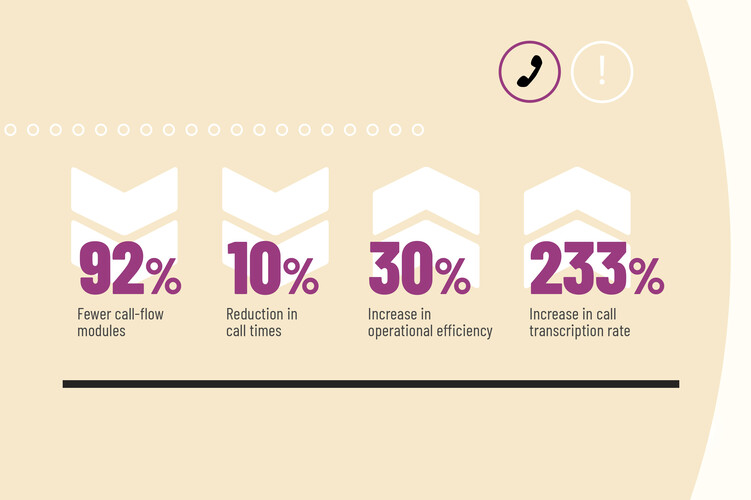
“The difference is structural, not cosmetic — the contact center is connected to the systems that hold the answers,” Kurtz says. We Insure blew past its initial target of answering 80% of calls in 60 seconds and is now answering that many in 20 seconds or less, he says. “We reduced the number of call-flow modules from 450 to 33 and improved our call transcription rate from 30% to 100% — those are the numbers I manage to, and every one of them moved.” 

In the end, Kurtz notes, consolidating data from different platforms has relieved We Insure’s contact center agents of the stress of walking into calls without context. Instead of toggling back and forth on multiple screens and asking for details they should already have, reps can now focus on listening to callers and giving them exactly what they need. 

“Every call transcribed, notes written back automatically, agents seeing the customer before they say hello,” Kurtz says. “That’s a modern contact center operating the way it should. It’s made us a better company.” 

EXPLORE: How to modernize your customer relationship management with Salesforce.

System Integrations Bring Customer Data to Light 

Welcome to what customer experience (CX) experts are calling the latest evolutionary stage in contact center technology: platforms that solve the problem of fragmented customer service data siloed in disparate and hard-to-access systems. 

“We’re finding in our research that companies in general value unification in their contact centers,” says Robin Gareiss, CEO and principal analyst at Metrigy. “They want technologies that allow them to integrate as many applications as possible.” 

Driving this trend is the realization by customer service leaders that successful CX depends less on adding new channels than on giving agents and managers access to better information. With contact centers that centralize data from systems as varied as CRM, ticketing and sales — and, in many cases, leverage artificial intelligence — “you can start to maintain context across your customer interactions and workflows to both operate more efficiently and provide personalized responses to your customers,” Gareiss explains. 

Personalization is the goal in every customer interaction for the 85 members of the customer service team at Central Bank in Columbia, Mo. Billing itself as a “people-first organization,” the community bank serves customers at more than 150 locations in Missouri and across the Midwest. 
A few years ago, says Mary Beth Gillum, Central Bank’s senior vice president of customer service, her team was relying on live switchboard operators to answer and route thousands of calls every day. That changed in 2025 when the organization deployed a cloud-based contact center from Five9 that automates the work using natural language processing. 

“It makes us so much more efficient, but it’s also much better for our customers,” Gillum says. The Five9 system is integrated with a CX platform that transcribes and analyzes every conversation for real-time visibility into customer interactions. Self-service tools allow customers to resolve most basic issues on their own, but bank representatives are always waiting in the wings should a caller require more support. 

“If their situation is complex or if things start to escalate as they’ve been chatting with a virtual agent, the system connects them with a live person,” Gillum explains. Later, her team can access reports and dashboards with data on everything from the reason for the call to customer sentiment and agent performance. Ultimately, the team can use that information to make changes that further enhance service. 

“We’re always looking for training opportunities — for anything we can do to improve the customer experience,” Gillum says. The bank’s net promoter score, a popular CX metric that measures a person’s likelihood of recommending a company or product to someone else, is consistently among the best in the country, she adds. “It’s important to us that customer satisfaction is high, and technologies like this contribute to that.” 

READ MORE: Find out how AI is reshaping the customer experience beyond individual interactions.

These Are the Tools That Improve Customer Experience

Homestead Financial Mortgage has similarly equipped its contact center team with tools tailored to optimize customer service. Providing personalized mortgage solutions to customers in nearly two dozen states, the Chesterfield, Mo.-based company relies on RingCentral as its primary communication platform. 

The AI-powered, cloud-based solution is integrated with the company’s Salesforce CRM and is used not only to answer incoming calls but also for customer outreach. Approximately 20 loan officers and client services representatives leverage the system’s Voice over IP technology via softphones installed on their computers. 

Before it moved to RingCentral, says Homestead CIO Jim St. Gemme, the company’s contact center revolved around two distinct pieces of technology: a traditional phone system with handsets and keypads and, separately, “two servers housed in our data center that basically just recorded all of our calls.” 

Homestead’s new system does away with that model. Today, calls, video meetings, team messaging, SMS texts and faxes coexist in a single package, St. Gemme notes. The organization no longer needs onsite data storage since all interactions are logged in the cloud, and it now has access to a suite of modern tools that streamline every aspect of customer service. 

Through the AI Conversation Expert platform, for example, RingCentral automatically generates summaries and transcriptions for each customer call and populates Homestead’s CRM with relevant information to reduce the need for manual data entry. It also provides agent coaching tips in real time based on analyses of conversations. 

“When you finish a call, it gives you a follow-up task that you can copy and paste into an email and immediately send to the customer,” St. Gemme says. “It makes sure the customer knows that they were listened to, but then it also sends everything to Salesforce so the data is available to anyone else working on that customer’s file.” A mortgage underwriter, for example, might want to see a summary of the conversation the customer had with their loan officer. “It makes that process easier and gives them a more holistic picture.” 

Like contact center agents at many companies, Homestead’s agents generally follow a script each time they answer a new call. They get their customers’ names, introduce themselves, explain their job and that they’re there to help, and then the real conversation unfolds. St. Gemme notes that Homestead’s contact center solution helps its agents do their work at a level that otherwise might be impossible, and it has improved customer experience and satisfaction. 

“It’s one of those technologies we don’t just use,” he says. “We actually depend on it.” 

Photography by John Davidson
Close

New Research from CDW Explores AI and Cybersecurity

Learn how AI is helping IT teams manage risk and improve resilience.