





How FedEx Gets Ahead of Logistics Problems
Great American Ballpark delivers a vivid example of a shift taking place across industries: Organizations are moving beyond analytics that explain what happened yesterday and toward systems that help employees decide what to do next. Real-time data analytics matters because the value of information can decline quickly when decisions cannot wait.
“Real-time data analytics enables businesses to process and act on data as it is generated, leading to faster decision-making, greater operational efficiency and improved customer experience,” says Houbing Herbert Song, a fellow with the technical professional organization IEEE. Latency reduction is particularly important for applications such as financial fraud detection, behavior monitoring and dynamic pricing, he says.
The distinction is between information that merely describes the business and information that can actively influence it. The technologies and use cases differ depending on the industry, but the underlying goal is similar: Put trusted information in front of the people and systems that can act on it quickly.
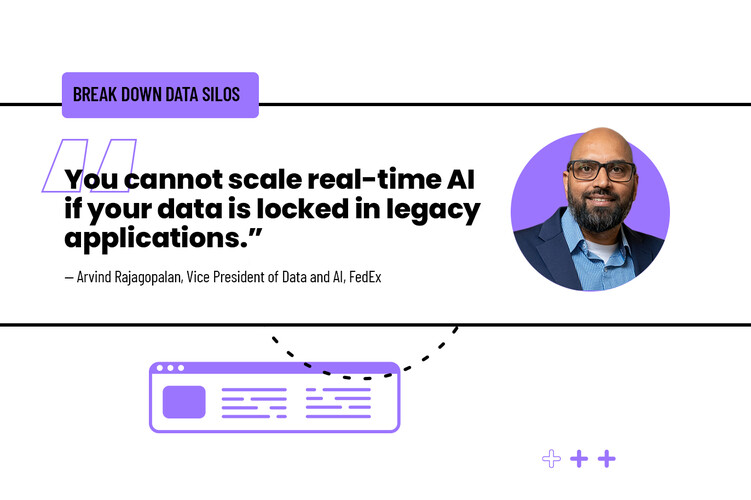
At package delivery giant FedEx, it’s all about using data and artificial intelligence to anticipate disruptions across one of the world's largest logistics networks. “We’re helping customers and team members anticipate potential disruptions, make more informed decisions and take action earlier,” says Arvind Rajagopalan, vice president of data and AI at FedEx.
The company is using Microsoft Azure to deliver real-time analytics across its network, with the goal of improving visibility and operational efficiency. Data and AI have become increasingly important competitive differentiators, Rajagopalan says, helping FedEx provide better service, operate more efficiently and create new value for customers.
WATCH: How to overcome the top five data challenges businesses are facing today.
The difference between traditional reporting and real-time intelligence is particularly important in a logistics environment. Rather than simply reporting what happened, predictive insights allow FedEx to help employees, and even customers, make faster, more informed decisions. AI can push that capability further by analyzing operational and delivery data in near real time, identifying potential service issues, recommending actions and enabling intervention before a customer is negatively affected.
At the same time, the company is simplifying its technology environment to support those ambitions, with plans to retire legacy systems and integrate AI into 50% of its operational workflows by 2028, Rajagopalan says.
“Our future technology platform will be an agile, cloud-first system that seamlessly integrates AI, data and modern engineering,” he says. “This modern technology stack will accelerate innovation, elevate customer experiences and power every part of the business.”
At FedEx, that means embedding AI directly into operational workflows rather than treating it as a stand-alone technology. The objective, Rajagopalan says, is to build the data, infrastructure, workflows and capabilities required to integrate AI across operations and deliver measurable business outcomes at scale.
That requires discipline. “It is easy to get distracted by the latest AI hype cycle,” Rajagopalan says. Instead, IT leaders should keep the broader business objective in view. “When the IT team focuses on improving outcomes for the customer, we’re more likely to make a greater impact across the enterprise as well,” he says.