



Oct 23 2026
Data Analytics

How Edge Computing and AI Are Transforming Industrial Operations

Industrial organizations are investing in onsite computing to enable real-time decision-making in production environments and accelerate AI adoption.

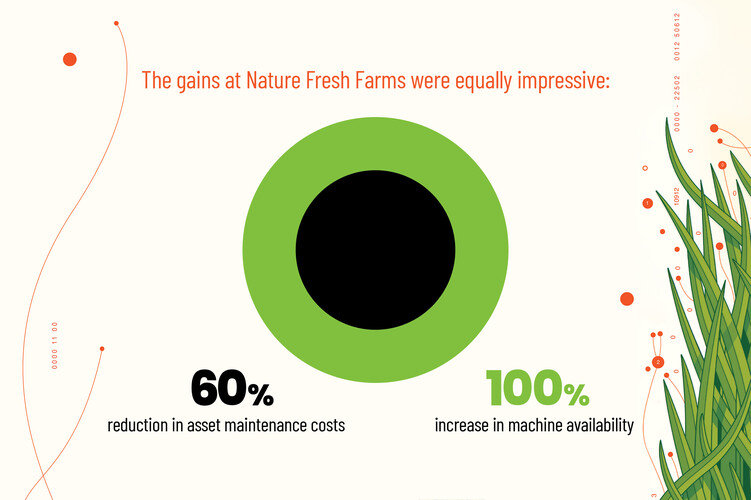
Almost all of the edge investments made by Nature Fresh Farms are organized around a common goal: maximizing quality and yield from the company’s 250 acres of greenhouse space in the United States and Canada.  

“We look at it as, how do you use less energy to produce more crop?” says Keith Bradley, the company’s vice president of IT and security. “Even though the footprint is the same, how do we optimize things? It’s the same for the packing line. How do we know what to sell, and how do we make sure it’s 100% good to go?” 

In 2024, Nature Fresh Farms invested in Dell Distributed Private Cloud, which provides local compute in the company’s greenhouses. The infrastructure brings real-time analytics to the edge, where the work actually happens, rather than sending data out to the cloud, and the company uses it to run AI workloads that automate decisions on everything from lighting levels to irrigation.  

Edge computing has long played a role in industrial environments, with manufacturers often favoring IT architectures that place processing and control close to the machines that create the most important production line data. But the role of the edge is changing — and growing — as leaders seek to support AI solutions that make decisions and recommendations based on real-time data.  

“This is something that the industrial world had done for a long time,” notes Niels Andersen, principal analyst and research director at LNS Research. “You need the ability to have compute or control wherever you want to have autonomy. But there is a lot that is new, including the networking, the cloud, AI tools and cybersecurity requirements.”  

Click the banner below to unlock insights to modernize your workplace. 


The Value of Analytics at the Edge

Nature Fresh Farms collects information on roughly 3 million plants every day, including data on light exposure, irrigation, humidity, nutrients, plant weight and production volume. By pulling each of these levers slightly in one direction or another, Bradley explains, the company can not only optimize yield but also improve the taste of its bell peppers, cucumbers, tomatoes, strawberries and other produce.  

“Plants want to be healthy living organisms,” Bradley says. “They like to eat at certain times, and we need to react to what they need in real time. On a day like today, when it’s super sunny out, we are watching how many joules of energy that plant will receive. We’re going to say, ‘Wow, it’s hotter out today than we expected, the plant probably needs a little bit more irrigation or more food.’ The goal is to increase yield, but also to make sure that you’re getting that proper-tasting tomato and cucumber. Because if it’s not grown properly, it’s not going to taste right.”  

Much of this information is generated by operational technology that was never designed to share data with outside systems, including growing and packing-line systems that operate on private networks with no direct internet connection. The Dell infrastructure, facilitated by automation software, interfaces with these systems and pulls data into the local edge environment.  

This architecture gives Nature Fresh Farms improved visibility into operations. For example, packing-line production was previously recorded manually, but today leaders can see production volumes in real time, letting them alert growers and sales teams when output is running above or below forecasts. This just-in-time information is especially critical in an industry where products have a shelf life, Bradley notes.  

The company also runs computer vision workloads at the edge, using AI-enabled cameras to examine boxes of produce and flag items that differ in color from the rest. Then, operators replace the outliers, resulting in boxes where all fruits or vegetables are at the same stage of ripeness.  

“It’s not like a car or a part that you build,” Bradley says. “Our products actually have an expiration date, and that expiration date has already started the moment we box it up. Analytics has to happen right there at the edge so we can make decisions right away.”  
 Sources: Siemens Energy and Nature Fresh Farms 


Hybrid Infrastructure Makes Sense for Industrial Businesses

Organizations are moving away from placing their manufacturing execution systems entirely in the cloud due to cost and reliability concerns, according to LNS Research. “We have found very clearly that the desired solution from customers is a hybrid system, which is a combination of edge and cloud together,” Andersen says. “The manufacturing companies that are successful are moving in the direction of hybrid architectures, where there are some things that are on the edge and some things that are in the cloud.” 

Siemens Energy, for example, moved away from what Mario Pilz, the company’s chapter lead for industrial IoT, calls a “cloud-centric” approach, shifting toward preprocessing manufacturing data closer to the source. “We figured that some applications and business capabilities, especially around AI, are best served directly on the edge,” Pilz says. “That can be for real-time capabilities, export control, regulatory reasons, costs and definitely latency.”  

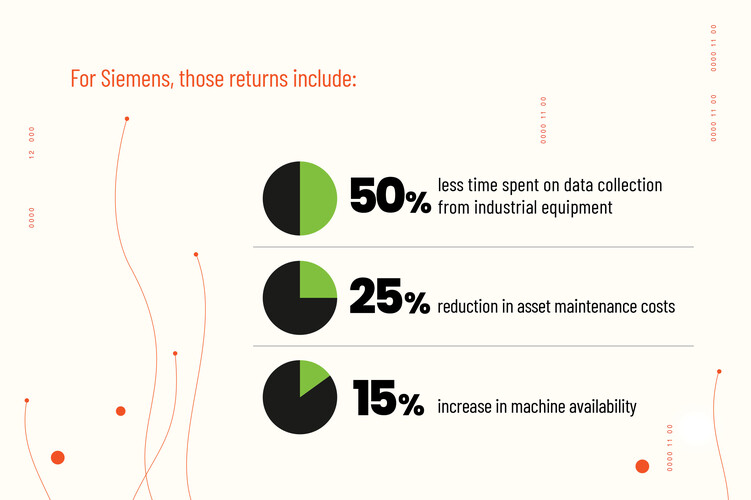
The company adopted Amazon Web Services IoT SiteWise, which collects, organizes and analyzes data from industrial equipment at scale, including information on temperature, vibration, alarms and power consumption. The information comes from assets such as drilling, milling and boring machines, robots, furnaces, vehicles and other equipment, and it is processed locally using no-code workflows. Then, it can be sent to AWS, kept inside the plant or routed elsewhere, depending on the use case.  

Siemens Energy uses a solution called EasyEdge to translate the many protocols spoken by industrial equipment into standard protocols, offering a consistent way to ingest and process data from a wide range of assets. The company now uses this approach at more than 40 factories.  

DIG DEEPER: Learn how agentic AI is becoming the future of smart manufacturing. 

Industrial Businesses Combine AI and Edge 

Scaling the model required Siemens Energy to simplify how edge infrastructure is deployed and managed. In the past, Pilz notes, setting up an IoT device at the edge required specialized server administration skills. Today, factory employees can request a new industrial PC through ServiceNow, select the appropriate network and cloud configurations, and create a custom image in roughly five to 10 minutes.  

Increasingly, the edge infrastructure is supporting AI and machine learning. The company is piloting containerized AI applications on existing edge compute, combining real-time production data with historical information to detect anomalies and identify potential quality control problems. For example, Pilz points to the ability to monitor humidity in 3D-printing environments, to detect abnormal voltage levels and to use existing process data to predict defects in product coatings.  

Edge processing and AI can also support predictive maintenance, Pilz says. By monitoring variables such as vibration and power consumption on pumps and other equipment, operators can identify abnormal behavior before an equipment failure takes production assets offline. Longer term, the company is pushing toward physical AI, in which edge-based systems not only detect problems but also adjust parameters in real time to optimize efficiency and productivity.  

“We make different decisions today in our everyday work compared with last year, because of AI,” Pilz says. “It has had a tremendous impact.” 

Illustration by Harry Campbell
Close

New Research from CDW Explores AI and Cybersecurity

Learn how AI is helping IT teams manage risk and improve resilience.