BIZTECH: Is this a short-term problem, or can we expect these challenges to continue indefinitely?
Nguyen: The supply chain pressure is likely to persist for the foreseeable future, driven largely by sustained demand tied to AI infrastructure. Memory constraints remain a key bottleneck, and current manufacturing buildouts are not expected to close the gap until at least the late 2020s, with some projections extending closer to 2030. While there is ongoing debate about whether the AI boom will normalize, the underlying demand for compute and storage continues to outpace supply. Absent a breakthrough that significantly improves efficiency at scale, the pressure on infrastructure and the resulting supply constraints are expected to remain.
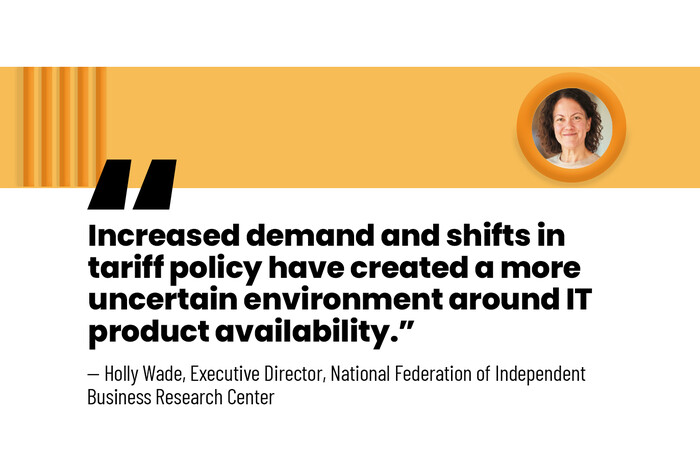
Wade: The supply chain crunch is likely to be a medium-term challenge, driven by sustained AI investment and shifting trade policy, with supply and demand expected to take time to rebalance. In the meantime, while most businesses can still access the technology they need, they are facing higher costs for equipment and components, adding to broader cost pressures that must ultimately be absorbed or passed on to customers.
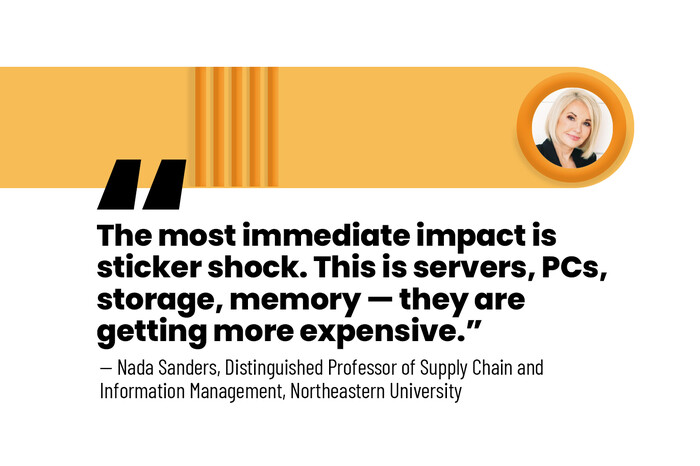
Sanders: This is not indefinite, in my opinion. There are forces that will eventually rebalance things. Massive global investment is underway, and as markets adjust, governments and companies are pouring money into capacity. The U.S. and European Union have created semiconductor incentives, and there are new fabrication resources opening across Asia and North America. This will increase total supply meaningfully by 2028. Another factor is that over time, technology improvements will reduce pressure. AI models will become more efficient, and new architectures will reduce hardware intensity. This helps stretch existing supply further.
REVIEW: Limited-time deals on hardware and peripherals for small businesses.
BIZTECH: What else would potentially ease the crunch?
Sanders: Easing this crunch comes down to either increasing supply meaningfully or reducing how fast AI is consuming it — basically, supply and demand. The biggest levers that could move the needle are things like new fabrication capacity becoming available. Major expansions from TSMC, Samsung and Micron are already underway. This is the single biggest long-term relief valve, but it will arrive slowly because it takes three to five years for them to build.
Another option for which I hold out hope is AI demand becoming more efficient. Right now, AI is extremely hardware- and energy-hungry, but that won’t stay constant. Improvements could include more efficient model architecture, better training techniques, data compression and reducing memory needs.
Wade: Companies are working to increase capacity, particularly in response to AI-driven demand for key components. But progress is constrained by changes in trade policy and the complexity of scaling semiconductor production. Even large domestic investments in chip manufacturing are highly specialized and slow to ramp, meaning they only address a portion of overall demand. How quickly the situation improves will depend on continued investment levels, policy stability and the pace at which new capacity can come online — likely over a multiyear horizon.