Eager to take advantage of the promised efficiency improvements, large businesses are going all in on artificial intelligence. While many have already realized measurable gains, challenges on the path remain. Even in these early days, leaders find more ways to deliver meaningful outcomes.
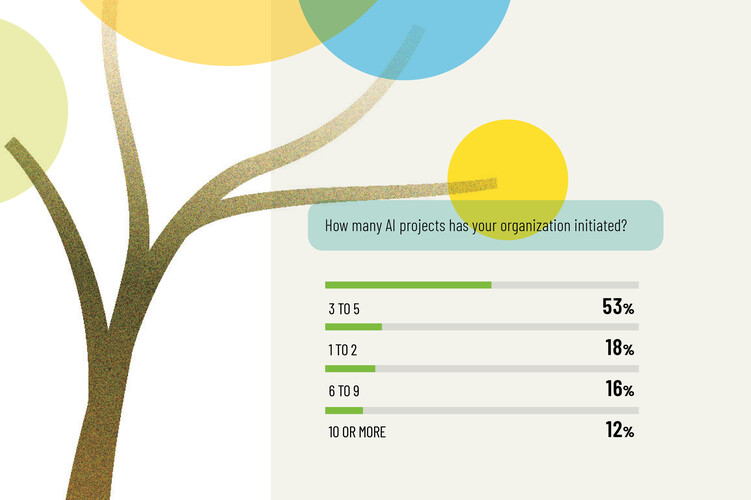
Among businesses employing 250 or more, those that have vigorously pursued AI projects have also reported early returns on their investments, according to a CDW survey on AI implementation conducted in December 2025. Most respondents say their organizations have so far achieved positive ROI on AI-focused projects within a year or less of launch. Yet, security concerns and data integration issues still stand in the way of implementing AI projects and realizing positive returns even faster.
Click the banner below to learn how to turn complexity into a business advantage.
A winning AI strategy must align tightly with business strategy, "and take into account where you are making bets in the organization,” says Matt Rosenbaum, principal researcher in the Human Capital Center at The Conference Board, a nonprofit think tank supporting the business community. A solid strategy ensures the business makes "those bets in places where you can actually show value relatively easily,” he says.
BizTech connected with several industry experts to contextualize the survey's findings, uncover advice and share compelling use cases that successfully advance mission priorities while bringing AI to life.
DIVE DEEPER: Learn what you'll need to build a foundation for scalable AI.
What Drives Rapid ROI on Enterprise AI Projects?
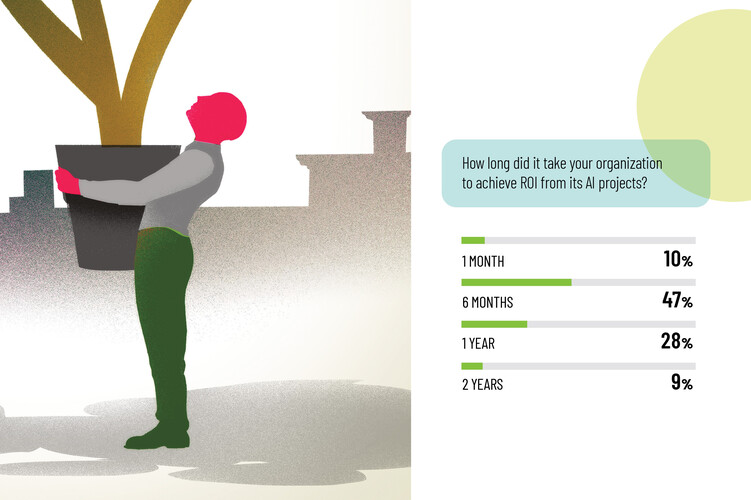
While 85% of surveyed organizations reported positive AI ROI within a year of project launch, some organizations achieved positive ROI within one to six months.
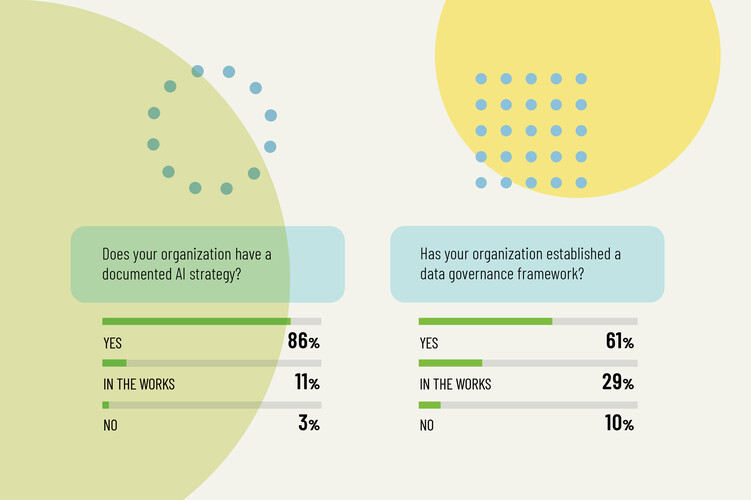
How did they arrive there so quickly? Nearly every enterprise surveyed also has an AI strategy in place or in the works. Strategy aside, many AI tools remain relatively affordable for enterprise users, which makes positive ROI in many ways the norm rather than an outlier, says Sam Ransbotham, a professor of business analytics at Boston College’s Carroll School of Management. Ransbotham is also co-host of Me, Myself, and AI, a podcast that focuses on AI's use in business, sponsored by MIT Sloan Management Review.
“One of the fun things about ROI is that it’s both 'R' and 'I.' Right now, the 'I' — the investment — is pretty low,” Ransbotham says. “If you think about incremental improvements to existing processes, tools are doing these pretty well right now and at relatively low costs, particularly when the vendors are in the phase of grabbing market share through low-cost offerings."
Enterprises Had a Head Start In the AI Revolution
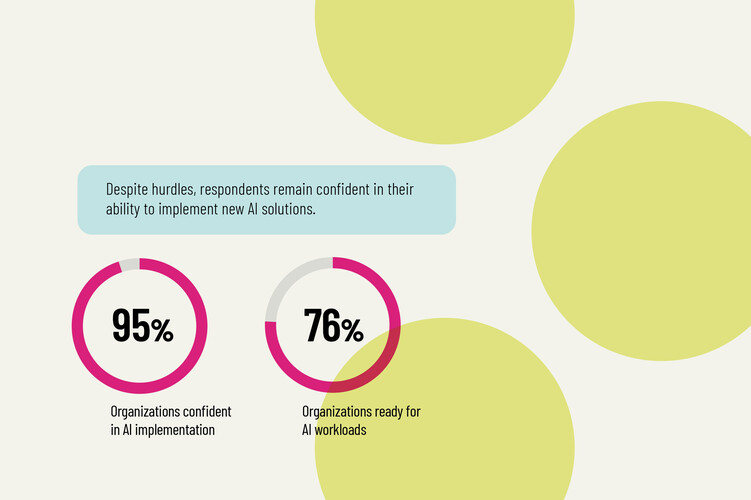
Even in the earliest days of AI experimentation and deployments, large business leaders say their IT stack was prepared: 76% reported having infrastructures in place capable of handling AI workloads, ranking their AI readiness at 4 or 5 (on a scale of 1 to 5). In some ways, that readiness also reflects the enterprise's urgency when it comes to AI adoption, notes Tracy Hardin, the author of How to Manage IT In Your Business and a member of the NAWBO Circle program, a peer group run by the National Association of Women Business Owners.
“They’re seeing great savings in time," she says. "They have seen what AI can do. They take a small bite and are committed. They’re committing the money for the internet connection, the infrastructure, the switches — everything that makes this happen.”
WATCH: Artificial intelligence will drive efficiency for financial institutions in 2026.
Before the advent of AI, enterprise-scale organizations tended to take a more methodical view of their infrastructure, Rosenbaum notes: “Larger enterprises tend to have a more structured approach, whether they’re a Microsoft shop or using Google or AWS for their cloud provider. It tends to simplify things when there’s a more formal structure in place for things like setting up your data architecture or incorporating new systems.” With a solid foundation already in place, “there’s usually more attention paid to how that whole system works together, versus some smaller businesses whose structures are not as formalized."
With adequate infrastructure in place, many large businesses already had a head start on the AI revolution, Ransbotham says.
"This is building on probably a 10- to 15-year emphasis on data and analytics, a decade or more worth of investments in data infrastructures, digital transformation and automation processes,” he says.
How Will Cloud Trends Influence Future AI Projects' ROI?
Cloud infrastructure delivers early wins with AI as businesses look for solutions that deliver affordability as well as improved speeds.
“Right now, the cost of hardware is so expensive, thanks in part to AI. Buying servers, buying hardware — it’s expensive because we’re competing with these AI data centers,” Hardin says. “And the cloud is available faster. We’re seeing lead times of six to eight weeks to buy servers. With cloud, you can get up and running in a day.”
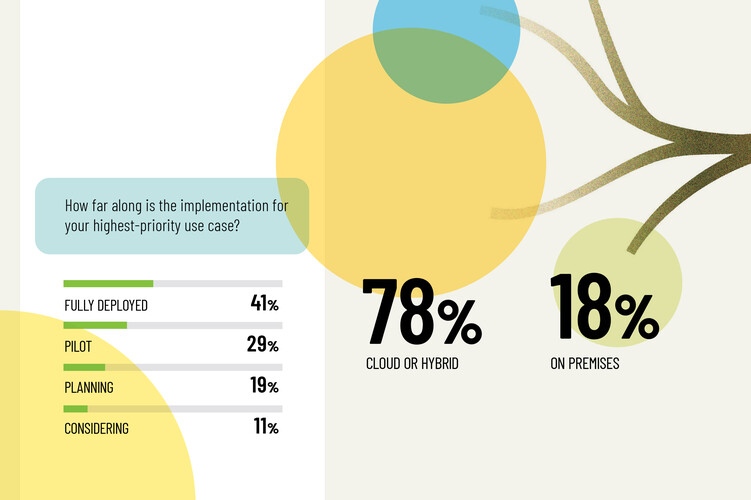
Affordability undoubtedly plays a role in where large businesses run AI workloads today: Most have opted for private clouds or hybrid infrastructure, with only 18% running AI on-premises, the survey shows.
Cloud providers hope to attract more AI workloads, and so far, that's kept prices more affordable compared with other solutions, Hardin adds. She predicts that balance will likely shift over time: “You’re going to see a turnaround in three to five years, where it will start to make sense to rethink bringing it back in house.”
Beyond cost, other considerations may keep enterprise AI in the cloud beyond the next three to five years, with performance and reliability topping the list, along with flexibility to scale workloads up or down as needs shift, Rosenbaum says.
Moreover, cloud providers are positioned to manage infrastructure more effectively, he says, and simply deliver more power through the latest technologies: “Optimizing GPU usage is a critical element that the hyperscalers are going to be able to offer as part of their service. If an organization takes that over on their own, they’re going to have to deal with that themselves, which is going to be painful.”
UP NEXT: Expanding AI agent adoption requires a culture shift.
What Challenges Stand in the Way of AI ROI?
Despite early wins, enterprise organizations still face challenges when it comes to full AI adoption, particularly around securing data and integrating data from a growing variety of sources or inputs. On the security side, issues with trust abound.
"Even if you as a vendor tell me it’s secure, that doesn’t mean that my organization will take that at face value,” Ransbotham says. That’s indicative of a larger sticking point: change management.
“We act like the AI technology is 90% of the problem, and it’s not," he says. Different types of organizations, their people and processes, as well as the contexts in which data is gathered or used, all bring new security, adoption and governance issues into the equation, and they all have the potential to get in the way of an effective AI deployment.
“Everyone is figuring out how to clean their data, or if it is clean, how to maintain it. Who is accountable for that?” Rosenbaum says. Those questions, in turn, raise additional questions around integration.
“AI use cases will often require data from across different parts of the organization, and you need people working together in ways that may not have necessarily been the case in the past,” he says. “It’s not just the systems that need to talk to each other; there’s also collaboration within the organization itself over maintaining that data and who’s accountable for it.”
Click the banner below to learn how AI is changing the cybersecurity landscape.
Where Do AI Projects Deliver the Most Value?
Enterprises have quickly realized success with AI in relatively low-hanging-fruit projects that deal largely with data analytics, improvements to end-user experiences (both internal for employees and external for customers), chatbots and security workflow automation. Those are the same areas in which respondents noted ROI was realized almost immediately, according to the survey.
Experts see a few common themes across those focus areas: “In all those cases, there’s some part of a process that’s got an inefficiency in it, or a slow piece,” and AI can help to automate or accelerate those elements, Ransbotham explains.
Those business needs and corresponding AI solutions also benefit from the velocity at which AI can solve the problem.
“You can’t beat it for speed,” Hardin says, whether that’s in data analysis or cyber response. When it comes to user experience, a company may produce multiple test sites to quickly determine the solutions users prefer. “AI can help to build those websites fast. It will see the patterns, provide reports and tell you where to make changes.”
From analytics and cybersecurity to customer service, successful enterprise use cases also share a high degree of measurability. When those measurements also share alignment with the business's mission and expected outcomes, it’s easier to prove ROI and project value.
“With good baseline data, you can tell whether the AI actually provides value, or whether the AI output was successful. That speeds up your use cases for AI, as well as how quickly you can determine whether you're deriving value from it," Rosenbaum says.