



Sep 28 2026
Artificial Intelligence

CDW Summit 2026: Agentic AI Requires Planning at the Infrastructure, Process and People Layers

Whether you’re looking at building artificial intelligence factories or just wrapping your head around lower-level chatbot usage, agentic AI requires planning and governance.

In all of the crystal-ball conjecture that happens around agentic artificial intelligence, many wax poetic about its potential to supercharge productivity, replace workers and manifest scientific breakthroughs.

But the reality of making agentic AI work for your business has much more to do with something that’s perhaps not as mystical: planning and governance.

At the 2026 CDW Summit in Dallas, there were two key sessions that helped make this point quite clear.

The first one was titled “From AI Ambition to AI Factory,” and it was done in conversation with NVIDIA around how it consults and works with IT teams looking to build out AI factories. An AI factory is a company’s scalable decision engine. Think of it as an operating system that continuously gathers data, feeds it through algorithms to generate predictions and insights, and uses the results to automate decisions and improve itself over time — all with minimal human intervention.

Click the banner below to learn how organizations are unlocking artificial intelligence’s potential.


This term first came to light in 2020 from two Harvard Business School professors, Marco Iansiti and Karim Lakhani, who described it in their paper, “Competing in the Age of AI.” NVIDIA latched onto the term in 2022 during when NVIDIA CEO Jensen Huang used the term during the 2022 NVIDIA GTC Keynote.

Today, NVIDIA has a team that specializes in consulting with IT teams that want to build system-level AI functionality and capabilities with AI factories. NVIDIA Vice President of Americas Charlie Wuischpard likens the company’s philosophy on building AI factories to that of building a five-layer cake.

The Five Layers of NVIDIA’s Framework for AI Factories

The structure for NVIDIA’s framework takes a top-down approach to AI factories, starting with the industry and organizational applications of AI and drilling all the way down to considerations around energy infrastructure.

Here are the specific five components of NVIDIA’s AI Factory framework:

  • Applications
  • Models
  • Infrastructure
  • GPUs (chips)
  • Energy

Starting at the top layer, applications, this is where a lot of the societal-level conversation is happening beyond just the IT discipline, as the applications of AI technology to solve real-world problems are what non-IT people are experiencing, experimenting with and testing out. And some of that experimentation could lead to some exciting breakthroughs.

“The super-exciting stuff is the applications and the way the technology is being used to move innovation,” said Wuischpard. “We all have chatbots, we all use it to enhance our day. I sometimes get a little sick of the AI-generated PowerPoints, because they can be wrong sometimes, but some of the really cool stuff happening, and I’m honored to have that sort of visibility, is, for example, in digital biology.”

“Let’s think of that as drug discovery developing new drugs faster. Almost every large pharma company today has, believe it or not, a machine now between $100 million and $500 million and growing. But it costs billions of dollars to bring a new drug to market, so that spend is kind of understandable. And anything that gives an edge is a huge advantage,” he added.

The model layer is where the ongoing debates and discussions around open-source and open-weight models are happening, including household names such as ChatGPT and Claude. From Wuischpard’s perspective, he sees both open-source and frontier models as adding value to the overall AI ecosystem.

Charlie Wuischpard
So, the key thing that you’re seeing here: Build for change, model agnosticism and resiliency.”

Charlie Wuischpard Vice President of Americas, NVIDIA

“We believe innovation will move fastest with a healthy open-model ecosystem. That’s not to take away from what the frontier providers are doing; it’s to add on,” said Wuischpard. “We also believe that it’s going to make a more secure and durable environment for us as businesses and as a country as well. So, we’re all in on open models.”

At the infrastructure layer, NVIDIA is focused on building out more data centers, grappling with gas-turbine generators that are backlogged for three to five years and adding more transformers to the grid to circumvent the current restraints that limit the ability to stand up more AI factories.

On the GPU front, which is NVIDIA’s legacy bread and butter, the chip supply is incredibly constrained, which is impacting not just AI factories but the tech industry overall.

And then there’s the need to find new and renewable sources of energy. NVIDIA has been having conversations with the Department of Energy on increasing energy capacity in the near-term and long-term.

Agentic AI in the Workplace Needs Governance and Strategy

While the NVIDIA conversation on agentic AI was all around the structures, capacity, energy and capabilities needed to stand up and sustain AI technically, “The Agentic Enterprise” session with Ben Weiss, VP AI Platform & Product Strategy at CDW, and Ben Holm, General Manager SME&C at Microsoft, centered much more on the actual day-to-day workplace use cases for AI for the average worker.

One of most critical components that is often overlooked is governance around AI. Sometimes, what is dubbed chaos is really only chaos if governance doesn’t exist. For example, CDW has over 10,000 agents and doesn’t consider it sprawl because the company has a sound governance plan in place.

“On the surface, I can understand why it might look that way. But if you set this up from the get-go in the right ways with the right governance and dimension, it doesn't have to be,” said Weiss.

“And if you set it up in the right environment strategy from the get-go, with data loss prevention policies, identity and access protection, you can do this safely. You can do this in a way where you can give people a lot of capability, but not too much, and ensure that what they're able to build again helps spur them down this journey, helps bring scale to a lot of your agentic efforts, but does not put the company at risk.”

/
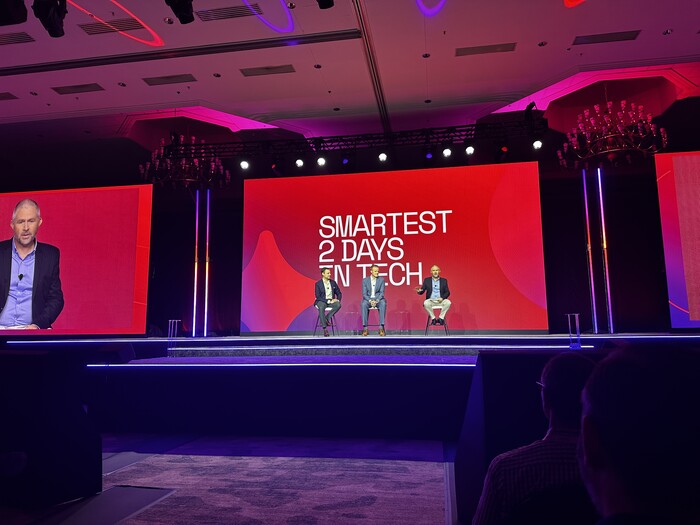
While onstage at the 2026 CDW Summit, Ben Weiss, CDW’s Vice President of Artificial Intelligence Platform & Product Strategy, and Ben Holm, General Manager SME&C at Microsoft, discuss their perspectives on agentic AI in the workplace.


Another reason why Weiss isn’t worried about the 10,000 agents active among CDW coworkers is that he remains in complete control.

“10,000 agents, I can log in in 10 seconds or less, anyone on my team or myself can shut down an agent if need be, understand exactly what’s going on there. That kind of observability is, I think, what goes along with that governance,” he said.

When it comes to ROI with AI, the jury is very much still out in many ways. But for Holm, it’s much more realistic to evaluate AI’s ROI from a strategic and opportunity cost lens rather than a dollars-and-cents one at this point.

“I think when you think really deep into ROI, you have to acknowledge we live in a constrained world. We don’t have nearly as much money or resources to do things that we would want, so we have to make decisions and figure out where to focus first,” said Holm. “I think indecision is a big challenge, especially as you get into enterprises, and I think the paradox is that in the moments of indecision where you’re not really making one, or for time, time will often then make the decision for you.”

The two discussed the fact that it’s best to not be locked into any one model right now. In fact, Copilot, which is made by Microsoft, allows users to switch between models from Anthropic, OpenAI and others, which gives businesses a meaningful level of flexibility with AI model adoption.

But while you don’t need to be locked into a model, it’s important that IT departments manage the number of models they want to support at any given time, as each model requires its own level of support and governance.

“Avoid the temptation to sort of get too many different platforms of AI within your organization, unless you feel you have the capacity to take on double, triple or quadruple governance requirements,” said Weiss.

Experts Say: Embrace the Agentic AI Culture Shift

Tapping into the promise of agentic AI requires embracing a level of openness and experimentation that likely feels to foreign many IT professionals who are somewhat wired to build and maintain control and restrictions.

But in both the NVIDIA and the Microsoft sessions, the takeaway was that, at this junction, there’s incredible value in implementing, experimenting and learning from a wide variety of agentic AI use cases, because everyone is trying to figure out what agents can really deliver in terms of value and productivity.

“We think that there’s a really important thing that underpins this phase, and that is that you’re transforming your culture,” said Weiss. “People are learning, and they’re being taught, sometimes through themselves and through these tools, what it means to embrace and to work with AI.”

DISCOVER: How to optimize your organization’s infrastructure for artificial intelligence.

“When you do start to consolidate in that next phase, you start to really bring top-down agents and put them into people’s hands,” he added.

The pace of innovation in AI is truly moving at breakneck speed, which is why embracing this moment of reinvention and transformation is how NVIDIA is advising its partners and customers to think.

“What we are seeing with some of our really AI-forward customers is they are building things for change,” said Wuischpard. “They are building systems that are resilient and modularized, so that no matter what comes up in the model world in the future, they can swap components in and out as long as they set the right foundation.”

“So, the key thing that you’re seeing here: Build for change, model agnosticism and resiliency,” he added.

Bookmark our 2026 CDW Summit conference coverage page to keep up with all of the articles and videos that we’ll be sharing.

Photography by Ricky Ribeiro
Close

New Research from CDW Explores AI and Cybersecurity

Learn how AI is helping IT teams manage risk and improve resilience.