


Sep 30 2026
Artificial Intelligence

CDW Summit 2026: What It Means To Be AI-Ready

Transformation is running through all aspects of business as AI pushes IT departments, infrastructure, people and processes to adapt.

The emergence of AI arguably represents the largest technological shift since the arrival of cloud computing, leaving many within the IT field in search of ways to define and shape what it means to be AI-ready.

In three talks at the 2026 CDW Summit in Dallas, leaders laid out varying guidelines and advice on how they are developing criteria on what being AI-ready might mean to them.

Despite different experiences and focus areas, there were a few consistent themes that kept popping up among the three sessions.

There was a clear call for speed, integration, resilience and flexibility, which is often the kind of advice that IT leaders give when describing technology best practices in general. But the use cases for AI are adding serious complexity to some of this advice.

Take a look at what IT leaders at the 2026 CDW Summit had to say about what it means to be AI-ready to get a better grasp on how you might evolve your thinking.

What It Means To Be an AI-Ready IT Department

Those who run the IT department are facing perhaps the most drastic changes as AI permeates its function. Some of these differences show up in the roles and responsibilities of IT professionals. In particular, with regard to operational IT, more IT departments should be ready to embrace AIOps as the new norm.

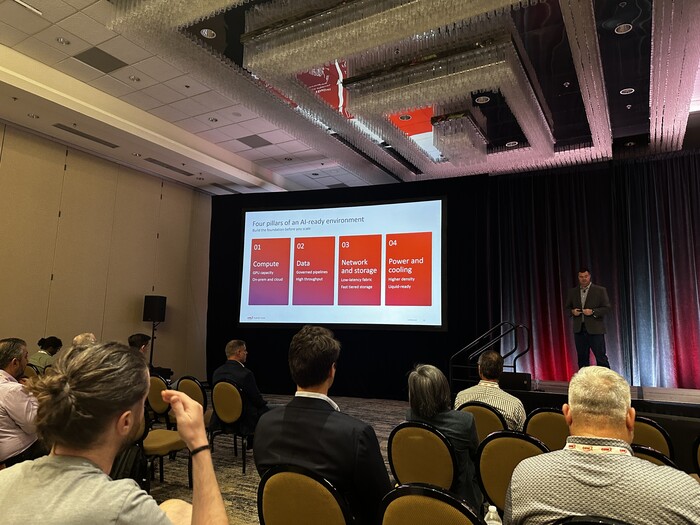
Marc Litten, CDW senior manager of AI factory and data center strategy, led a session titled “AI-Ready IT” where he defined AIOps.

Marc Litten
Marc Litten, CDW Senior Manager of AI Factory and Data Center Strategy, walks through his four pillars of building an AI-ready environment during his breakout session at the 2026 CDW Summit.


“AIOps is essentially taking the way you operate IT and weaving AI into everything you do,” he said. “It starts with integrated telemetry. If you do not have integrated telemetry across your environment and observability into your network, your server, your storage, your power and cooling — everything that's in that data center, whether it's in the cloud, on-prem, or in a colo — if you do not have the telemetry that you need to see what's going on, you cannot use AIOps. It needs that data to operate effectively.”

The need to be integrated across technology solution areas is a shift away from the specialist approach that many IT departments organized around in the past. Litten couldn’t help but muse on how different today’s AI-Ready IT professionals’ job descriptions are from when he started out in the business.

“I've been in this industry for 25 years now, and when I came out of college and went to work for IBM, there was one number that was important to every business in the world, and it was five nines availability,” he said. “If you had five nines uptime, your IT department was humming, and you were the pinnacle of success. And everybody was about five nines: ‘I'm up all the time, my business is happy.’”

Today, IT professionals are evaluated more on how quickly and effectively they enable productivity and business outcomes.

READ MORE: Why cloud is not a disaster recovery plan.

“In the last 10 years alone, downtime has not been a problem. I'm in multiple clouds, I'm in multiple colos, I have things that are running in so many places that I don't go down like I used to. I don't need my technology to be five nines,” said Litten. “I need my applications to be on all the time. Now, what they care about is how fast can you give me an outcome.”

Litten offered IT professionals in the room a 90-day action plan with three steps that he believes can get them AI-ready in no time.

  1. Get an honest assessment. Bringing in a third party to evaluate your technology, people and processes from top to bottom gives you an objective read on how close you are to being AI-ready, whether you’re 50% of the way there or ready to go.
  2. Pick one use case. Choose a single, focused application, such as automating firewall rule updates or ticket resolution, and make it a success. That win becomes the proof point you take to leadership to secure the green light and resources to scale across the department.
  3. Set clear guardrails. Define what you want AI to deliver before you begin. Whether the goal is higher productivity or bringing new products online in half the time, being explicit about the desired outcome keeps the effort focused and measurable.

What It Means To Build an AI-Ready Network

While Litten pointed out that always-on network uptime is no longer as remarkable as it once was, that doesn’t mean AI isn’t having a meaningful impact on the networking tech stack.

During a mainstage session called “The AI-Ready Network” with Cisco, CDW Senior Vice President for Hybrid Infrastructure and Managed Services Sanjay Pal suggested the AI-ready network is best observed through two lenses.
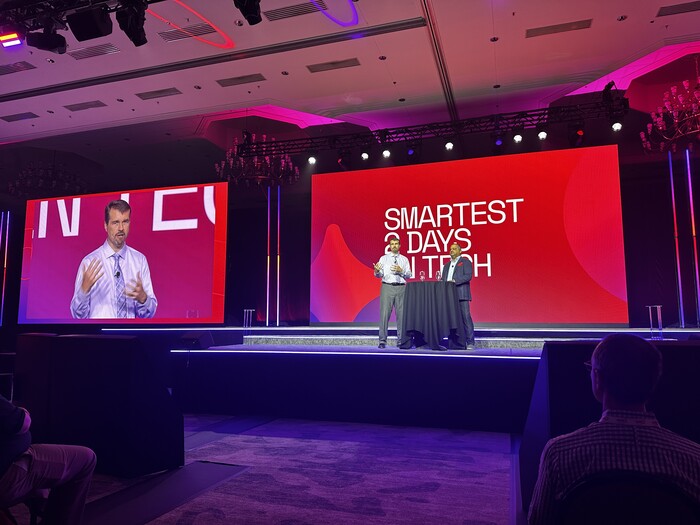

Mike Kraus, Sanjay Pal
Sanjay Pal, CDW Senior Vice President for Hybrid Infrastructure and Managed Services (right), and Mike Kraus, Cisco Vice President of Global Networking Solutions Engineering, discuss what goes into developing an AI-ready network on the main stage at the 2026 CDW Summit.


“Lens No. 1 is every pressure or every AI tool, every agent workflow that is coming on to the network fabric. The network needs to be able to support that,” said Pal. “It's not just about latency and throughput; it's about the security elements of it.“

“The second way to look at AI-ready networking is … we have to be able to make changes and adapt much more quickly to what we need,” he added. “Therefore, network engineering teams have to look much more closely at the adoption of all the enhanced AI capabilities. Not just into designing it, but migrating it, enhancing your environment, how you're operating it, how you're running it — all those things fundamentally will require all these wonderful enhancements happening with AI operationally.”

Cisco Vice President of Global Networking Solutions Engineering Mike Kraus doubled down on Pal’s point about connecting networking and security more in the age of AI.

“You have sustained traffic, and you have higher performance requirements, symmetrical, and at the same time, there are new security risks that are coming out that we need to be challenged with, where bad actors are using AI also,” said Kraus.

While evolving to becoming more AI-ready means re-examining network security, it also means reducing complexity where it’s not useful.

“If you think of what makes up the secure network or AI-ready network in Cisco's mind, first we have to deliver upon operational simplicity, and that's where we're bringing everything together with cloud control enabled by AI to do things faster, deploy services more quickly, to make configuration changes on your behalf, all back through AI,” said Kraus.

What It Means To Build AI-Ready Security

On the topic of “Resilience in the Age of AI,” leaders from CDW and Palo Alto Networks offered serious security advice, blended with levity as they sprinkled superhero references throughout the conversation.

All jokes aside, the sobering nature of the Hugging Face attack — one of the most newsworthy AI security incidents recently — framed the beginning of the discussion.

“AI is making this even harder for us to do, even harder for us to ensure that our organizations are agile and flexible enough to endure the unknowable, the next thing that we can't predict,” said Stephanie Hagopian, senior vice president of security and augmented expertise & intelligent staffing (AXIS) for CDW.

“There's this inherent paradox, this complexity to what we now face with these frontier AI models, because they're tasking us to build this new AI-ready resilience posture without slowing down our business. But for most of us, our businesses are also relying much more heavily on AI to speed our innovation and speed up our operations,” she added.

Stephanie Hagopian, Daryan "D" Dehghanpisheh, Dan Campbell
CDW’s Stephanie Hagopian (right) joins Palo Alto Networks’ Daryan "D" Dehghanpisheh and Dan Campbell to share perspectives on how IT leaders must adapt to achieve resilience in the face of dynamic security challenges brought on by AI.


Daryan "D" Dehghanpisheh, Palo Alto Networks’ North America go-to-market leader for AI security, observed that the way that AI functions and operates requires security leaders to recalibrate their calculus.

“AI is probabilistic. You've heard this for many years, and so as a result, how we think of software connectivity is just application programming interfaces talking to one another, but that's not how agents work,” he said. “So, you have to think about what AI does in a very different method with very different engineering capabilities and very different systems, honestly, in terms of how you build and protect and secure that artificial intelligence.”

This approach has led to a flurry of innovations from Palo Alto Networks in response to the landscape shift.

LEARN MORE: How companies can measure AI's ROI.

“We've announced quantum readiness inside the firewall, and we're doing virtual patching because we're now in a world where we patch every day, forever, for the rest of our lives,” said Dan Campbell, president of North America for Palo Alto Networks. “We do virtual patching, and we offer that inside the network. So, there's so much innovation that's happening even at the network layer or the cloud layer or the security operations center layer.”

As IT leaders reimagine their security strategies to manage AI, Dehghanpisheh recommends leaving no stone unturned, because AI can get into places you least expect it to.

“AI security is about the inside out, so if they're already in in there — whether it's a model, an agent, an actor, an insider threat, whatever — it's blowing a hole out of the firewall. So, you have to invert it,” he said. “As you think about security, from a network perspective, people would think about it as like north-south, east-west. The challenge with agents is that they go deep south, right? They go onto the local resources, they crawl your environments, they take activity, all in the hopes of making your life better and more productive.”

Bookmark our 2026 CDW Summit conference coverage page to keep up with all of the articles and videos that we’ll be sharing.

Photography by Ricky Ribeiro
Close

New Research from CDW Explores AI and Cybersecurity

Learn how AI is helping IT teams manage risk and improve resilience.