


Sep 30 2026
Security

Five Benefits of Modernizing Endpoint Management

Organizations across a wide swath of industries leverage tools to simplify operations and support growth.

In the business world, rapid growth typically signals a company’s success. Often, rapid growth also brings new challenges, including increased job complexities.

The Arcticom Group (TAG), a California-based commercial and industrial refrigeration and mechanical services provider, has expanded significantly in recent years to keep up with the needs of its growing customer base.

“Texas, Tennessee, New York, British Columbia — we were doing acquisitions all over the place,” says Geoff Brougham, TAG’s vice president of IT. “With each, we had more scattered assets. Everything required management and updating and patching.”

His team of 15 struggled to manage the mounting number of company-owned and acquired devices. They’ve since turned to an endpoint management solution from Tanium that’s made that job easier, but just a few years ago the team was telling an entirely different story, Brougham recalls.

Click the banner below to learn why cyber resilience is essential to enterprise success.


In every case, the small to medium-sized regional companies TAG acquired were not using sophisticated or up-to-date endpoint management tools. As each operation joined TAG, Brougham’s team needed to update and configure all of the new devices brought under their purview. At first, they attempted to do it all manually: “Somebody would submit a ticket, and when we were done, we’d say, ‘Hey, let’s do your updates right now,’” he says.

The ad hoc approach worked for a while, but also left some details forgotten or inconsistently applied. “It was never a complete effort, and it resulted in gaps left and right,” Brougham says.

As TAG grew to its current size of 26 operating companies in the U.S. and Canada, it became clear the company needed to do better: It deployed the Tanium solution after testing the product and seeing what it allowed the team to achieve, Brougham says. “It gave us visibility and control. We could really see where everything was and which users were active on what devices.”

DISCOVER: Learn how to secure remote devices with modern management tools.

The enterprise-grade solution also allowed them to easily push applications and controls to individual end users and automate patching across all machines and devices, allowing more proactive management of emerging vulnerabilities.

Today, Tanium remains TAG’s go-to platform for all things endpoint-related. The company recently deployed CrowdStrike agents for automatic device monitoring and protection, while other Tanium product features have provided anonymous use data and details about remote employees. The team has tasked Tanium with handling endpoint provisioning, Windows updates, service pack deployments and policy creation on the more than 2,500 devices now in use throughout the company’s ecosystem.

“It goes well beyond the bread and butter of asset management,” Brougham says. “It lets us do everything faster, and as we’ve grown, it’s allowed us to keep up.”
Platforms Drive Management Efficiencies Across Many Industries

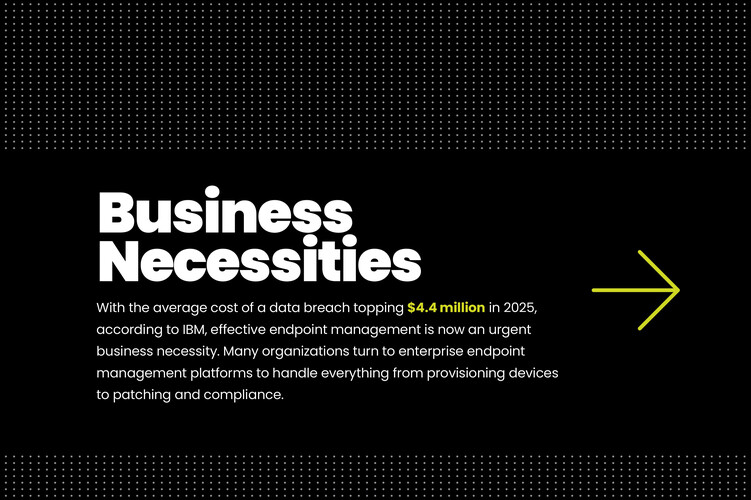
Across industries, organizations now leverage a variety of endpoint management solutions to simplify operations, reduce risks and support growth at enterprise scale.

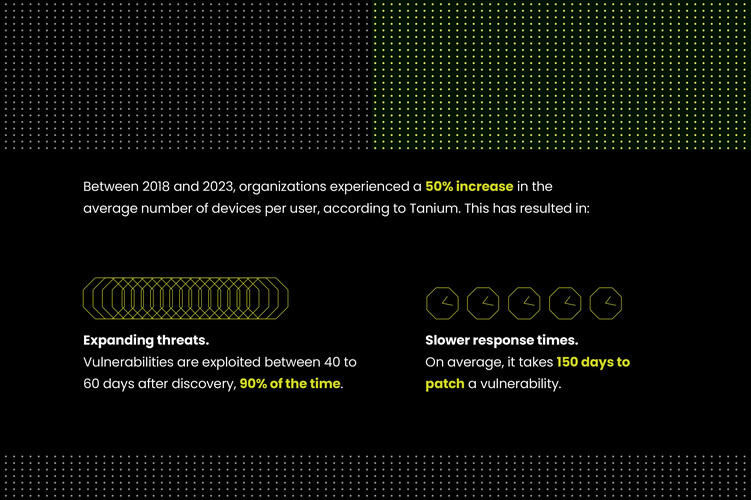
“IT teams are being asked to do more with less, even as their device landscape is becoming increasingly complicated,” notes Michele Pelino, vice president and principal analyst at Forrester Research. “If you need to make sure your devices are updated, endpoint management platforms help you do it as efficiently as possible.”

Endpoint management offerings from Tanium, Jamf, Ivanti and others offer a variety of features that appeal to specific industry needs, Pelino says. A financial firm may opt for one product because of its high-level privacy and security features, for example, while another company may choose a solution that packs more AI-enabled capabilities to speed up patching.

“Some platforms can take a while to get used to, while others are very user-friendly,” she adds. “The market is very fragmented. One solution is not necessarily the answer for everybody.”

At Make-A-Wish America, CIO Keith Goodwin works with a vast network of staff and volunteers to grant life-changing wishes to critically ill children and their families. Helping Make-A-Wish stay true to its mission is a top requirement of any tool Goodwin’s team deploys in support of the organization’s 57 chapters nationwide, including the more than 2,000 devices his team is responsible for securing and managing. “Everything we do in IT, we do with that goal in mind,” he says.

Keith Goodwin, Make-A-Wish
We take data protection very seriously, and that means patching and closing vulnerabilities.”

Keith Goodwin CIO, Make-A-Wish Foundation

A few years ago, Make-A-Wish moved primarily to Microsoft Surface laptops for its permanent staff, but the organization also leans heavily into personal devices, due to the many volunteers who work in offices or with teams in the field, he says. Chapters also frequently rely on donated equipment. The nonprofit’s endpoint management strategy required a solution that offered the flexibility to handle almost any device that came onto the network. Longtime Microsoft 365 and Azure adherents, the team determined that a suite of Microsoft solutions would get the job done.

Make-A-Wish relies on its primary endpoint management tool, Microsoft Intune, to push out application updates and depends on Windows Autopilot to navigate touchless configurations and device deployments to end users. The team also relies on Microsoft Defender for threat detection and endpoint protection.

Effective endpoint management is especially important at Make-A-Wish because the organization must responsibly adhere to strict regulations governing medical information and other private details from the nonprofit’s client families and children.

“We take data protection very seriously, and that means patching and closing vulnerabilities,” Goodwin says.


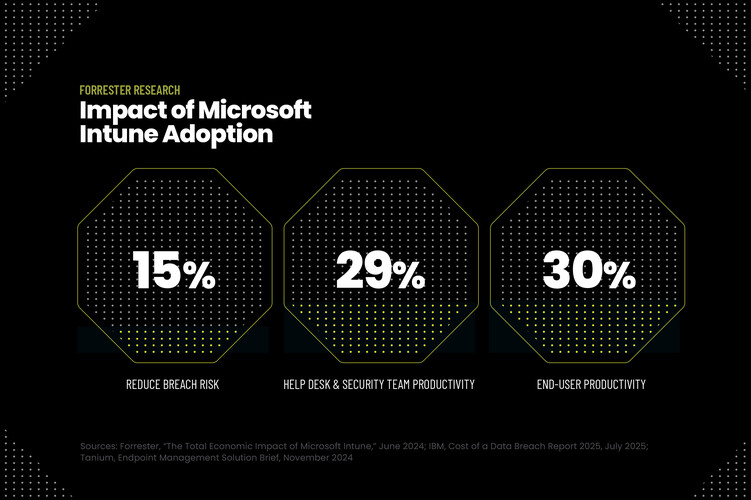
181%

The average return on investment for customers that deployed Microsoft Intune's endpoint management solutions

Source: Forrester, “The Total Economic Impact of Microsoft Intune,” June 2024

Endpoint Management Tools Shut Down Endpoint Threats

Since opening its offices in 2017, New Jersey-based Saphyre has scaled its operations on infrastructure built on Azure, providing and exchanging proprietary information for its financial institution customers. Saphyre took a cloud-first approach “almost from the start, because we required an environment that could scale efficiently,” says Brian Rojas, the company’s head of support. “Our endpoint management solution is part of that, and it allows us to do a lot with very little.”

Saphyre employs about 100 people and manages roughly 500 endpoints, Rojas estimates. Like Make-A-Wish, the company relies on Microsoft Intune to protect and manage its devices but also uses Microsoft Purview to maintain data security and compliance. 

UP NEXT: The benefits of centralized management of peripheral devices.

Given Saphyre’s reliance on Azure, the team deployed both solutions as logical, strategic management tools, he says. Together, they provide seamless integration between identity management, updates and patching, as well as data loss prevention.

When a Saphyre employee receives a new device today, the machine can be delivered “with all the policies, all the updates, everything ready to go,” Rojas says. Automation ensures that patching will happen on a regular cadence. As a result, his team sees fewer requests for help.

“There’s a lot less, ‘Hey, my computer’s not working because I didn’t set it up the right way,’” Rojas says. For him, that has also brought substantial time savings, as well as happier customers: “Most of what I do around endpoint management is so streamlined, our end users don’t even know that I’m there.”

Christina Gandolfo
Close

New Research from CDW Explores AI and Cybersecurity

Learn how AI is helping IT teams manage risk and improve resilience.