



Aug 12 2026
Cloud

Cloud-Based Data Management Delivers Massive Benefits in Financial Services

The sheer volume of data overwhelms on-premises systems, but cloud infrastructure reduces costs and shortens time to value.

At Aon, the world’s second largest insurance broker, data encompasses contract terms, policyholder characteristics, current policy values and more. Putting all that information to work — particularly at the quarter’s end — requires extraordinary compute power, according to Van Beach, global head of life solutions for Aon’s strategy and technology group.

“The scale that you need to execute these is beyond what most companies can handle within an internal data center,” Beach says.

Aon’s challenge is a common one in the financial services sector, where massive data volumes are typical. Many financial institutions are modernizing their data platforms to improve speed, scalability and analytic capabilities, and they are leaning heavily on cloud-based solutions, which empower them to meet the data needs of today and tomorrow.

“As you grow, you don’t have to buy new servers, you don't have to buy new disk packs, and you don't have to build out your own data center architecture to handle scalability,” says Jerry Silva, program vice president for IDC Financial Insights. “All that is built into whatever cloud platform you're using.”

Click the banner below to subscribe to our newsletter for the latest financial services IT insights.


The Financial Services Data Challenge

As an intermediary and broker in the insurance industry, Aon helps companies manage risk and capital. Technology supports its actuarial modeling use cases, including pricing, risk management and financial reporting. Over the past 15 years, the computations required to support these applications have increased exponentially. In many cases, the methodologies required to manage these risks and comply with the regulations require stochastic analyses —looking not at a single outcome, but at thousands or millions of outcomes. “The scale can be massive,” Beach says,

Others are in much the same boat. For Daniel Gicklhorn, chief platform officer at Apex Fintech Solutions, the challenge is not just volume but also quality. Zero data loss is a must-have at Apex, a cloud-based financial services company whose platform supports others in the industry that engage with individual investors.

WHAT'S NEXT? Capital One uses serverless to move faster with less ops overhead.

Apex must ensure that data never goes astray, even when volume spikes. A big trading day “will increase the traffic volume tenfold, and you have to maintain extreme reliability of data despite those spikes,” says Gicklhorn.

At Fiserv, Brandy Wood was hitting roadblocks. The company helps banks, credit unions and others to process transactions, manage accounts and deliver digital financial experiences. A heterogenous ecosystem, with data distributed across legacy on-premises environments, was creating friction for developers, clients and Fiserv’s teams. Siloed data constrained both efficiency and growth.

“Data needs to be provided in real time,” says Wood, Fiserv’s head of client experience product. “We had to rethink how we were going to deliver that data to meet those needs.”
Cloud Helps Financial Firms Manage Data Volume

Each of these companies leverages cloud to gain the needed edge. Aon uses Microsoft Azure SQL Database to consolidate actuarial and claims data, improving speed, reporting and analytics for insurance risk decisions. Cloud delivers support for all of the input data while enabling additional reporting and analysis.

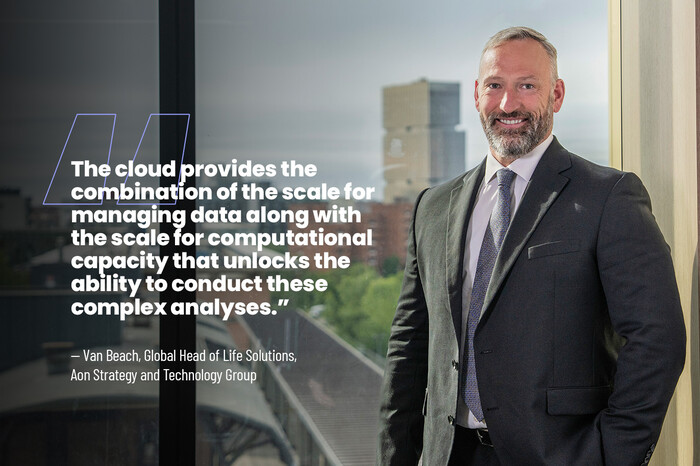
Legacy actuarial systems were built on CPU-based platforms. Cloud offers more powerful processing capabilities, with a single GPU able to handle the same volume of data as 500 or 1,000 CPUs running in a legacy model, Beach says: “The cloud provides the combination of the scale for managing data along with the scale for computational capacity that unlocks the ability to conduct these complex analyses.”

At Apex, Gicklhorn leverages a range of Google tools to enable the rapid launch of investment products and prepare the platform for AI-driven insights. He’s using a modern, cloud-native analytics stack built on BigQuery, Google Cloud’s serverless data warehouse, along with Google’s Looker for semantic modeling and business intelligence. A scaled, robust data lake is foundational to ensuring zero data loss, and BigQuery lets Gicklhorn manage that data lake at scale. This approach allows Apex to scale up on demand to handle spikes, and it delivers robust business intelligence. The cloud “provides us the ability to really think about scale differently,” he says.

Fiserv, meanwhile, is using unified application programming interfaces for e-commerce payments, streamlining developer access and accelerating partner integration. The company migrated hundreds of petabytes of data from on-premises environments to a cloud-native architecture. It also redesigned the data layer to standardize it, rather than continuing to do point-to-point integrations for different processes.

A normalized set of APIs sits on top of that data layer. “The savings came from retiring our legacy on-premises platforms, consolidating the data pipelines — where we ingest all of that data — and then eliminating duplicative engineering efforts,” Wood says. “Our goal is to build once and deploy that across our ecosystem.”

Van Beach, Aon


Financial Firms See Business Value in Cloud

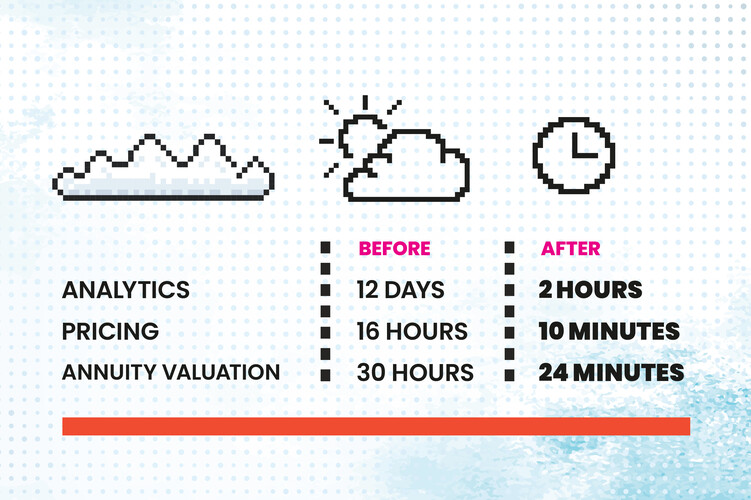
Beach says he’s seen a direct business impact with cloud. In one case, an analytical process that used to take 12 days now runs in just two hours. That reduction was achieved by addressing the interplay of the data processes and the model calculations: In the actuarial space, fast model execution is the key enabler, but optimizing for the interplay of data and calculations is the secret sauce, he says.

“We have also seen dramatic improvements in smaller, more targeted processes,” he adds. For example, a re-rating process that took 16 hours was reduced to 10 minutes. And a multistep stochastic annuity valuation process that took roughly 30 hours was reduced to 24 minutes through faster model runs and optimized, integrated data processes.

At Apex, the pivot to a cloud-based approach has helped Gicklhorn get away from interacting with clients on a set of static, overnight, batch-based systems. A unified data lake means clients no longer need to integrate differently with each asset class Apex provides.

GET THE DETAILS: What is data sovereignty in financial services?

Cloud has also changed the way Apex onboards its clients. “What used to take months — even more than a year for some clients — is now in a time frame of four to six weeks,” he says. “That's a huge change, especially at a time where there's so much other financial pressure to manage the cost and velocity of our clients’ businesses.”

And at Fiserv, migrating off legacy on-premises infrastructure has driven significant cost savings. By adopting elastic, consumption-based cloud services, the company reduced its data infrastructure cost by approximately 68%, Wood says.

By deploying unified APIs and standardized data services, Fiserv has seen integration timelines shortened by 50%, because clients are able to integrate immediately and then reuse that across different products and services that they consume from Fiserv. The company also saw a 500% increase in data-related revenue as it took data beyond simple core processing and made it something its clients could monetize.

Ryan Snook/Theispot
Close

New Research from CDW Explores AI and Cybersecurity

Learn how AI is helping IT teams manage risk and improve resilience.