In the banking industry, 2026 promises to be yet another tumultuous year in terms of technology. As artificial intelligence continues to reshape the business landscape, IT leaders in banking will drive ahead with their efforts to ramp up AI safely and effectively. At the same time, they’ll invest in other emerging capabilities, with an eye toward greater efficiency, improved resilience and elevated customer service.
As banks proceed through 2026, what tech priorities will separate leaders from laggards? To explore the question, BizTech convened a roundtable of IT decision-makers across the U.S. banking sector. They surfaced shared imperatives and explored how they are thinking through their execution strategies.
Participants included: Amy Brady, CIO at KeyBank; Dilip Venkatachari, senior executive vice president and chief information and technology officer at U.S. Bank; and Charaka Kithulegoda, executive vice president and business lines CIO at PNC Financial Services Group.
Click the banner to sign up for our newsletter and receive more business IT insights.
BIZTECH: What are your bank’s top tech priorities in 2026?
Brady: The Key Technology, Operations and Services strategy centers on enabling business growth, enhancing client and employee experiences, and simplifying how we work within KeyBank and with other KeyBank teams. Within our lines of business, we are focused on investing in our digital wealth platform, our commercial online banking system and our Virtual Account Management platform.
Beyond the lines of business, we are prioritizing investments in areas such as platform modernization, security and infrastructure. For example, we’re modernizing our recovery management system and strengthening our infrastructure platform to ensure our systems and platforms remain resilient.
Kithulegoda: Our priorities include accelerating AI adoption and maintaining robust security to drive growth and competitive advantage. We’re investing in sustainable technology, disciplined risk management and innovative business solutions — all designed to reinforce PNC’s position and prepare us for the future.
Looking ahead, our vision for 2026 centers on driving efficiency, investing to keep pace with AI-driven change, and equipping our employees with the skills to thrive, especially in leveraging AI tools.
Venkatachari: We’re looking at how we can innovate on the reliability and performance of our products and services that customers depend on. That includes how we scale AI broadly, within our responsible use framework, to provide even better monitoring, better visibility and better predictive maintenance for customers.
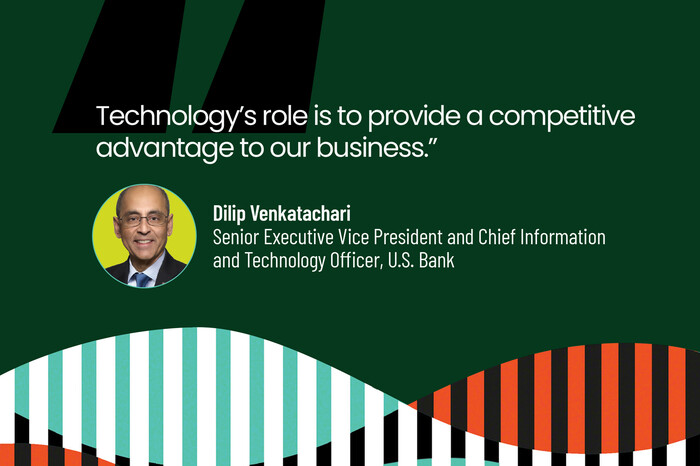
Technology’s role is to provide a competitive advantage to our business. So, our priorities align to the priorities of the bank. We’re focused on enabling the delivery of products and services that are competitive and supportive of our business goals.
BIZTECH: With AI a top priority, how would you characterize the banking industry’s success so far in terms of adoption? How would you characterize your own?
Brady: Key and other banks have had success in setting up program oversight, governance models and risk frameworks for deploying generative AI-based use cases. At Key, we have put a strong foundation in place through our AI leadership and review boards, as well as our AI program management office.
Most use cases have involved employee productivity and departmental productivity based on generative AI knowledge management, which provide efficiency benefits that have been hard to measure. Key is now focused — like other banks — on higher ROI-based use cases that involve leveraging new agentic AI capabilities. We feel that areas such as software engineering, fraud, AML, contact center, frontline sales, loan operations and collections have the most opportunity.
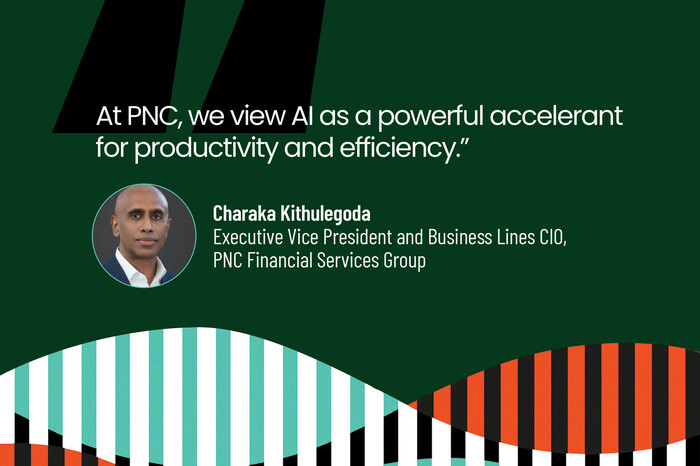
Kithulegoda: AI and automation are transforming operations across the banking industry and beyond. After years of piloting use cases, the industry is now seeing real impact. At PNC, we view AI as a powerful accelerant for productivity and efficiency. From enterprise-wide AI deployments to advanced machine learning operations, we’re unlocking insights that better support clients and the bank.
A recent example: An agentic AI solution supporting my team’s coding efforts delivered measurable gains in both efficiency and accuracy — proof of the potential we’re harnessing.
Our commitment to AI is grounded in responsibility. We’ve taken a deliberate, measured approach built on quality data and strong governance to ensure every deployment is secure and sustainable.
Venkatachari: I believe the financial services and banking industry has done a good job of adopting AI — in fact, better than what many would imagine in terms of going “two feet in” on AI.
What I’m particularly proud of at U.S. Bank in our adoption of AI is how we’ve managed change — our ability to move from early concepts of pilots to production, and doing so in an outcome-oriented and responsible manner.
BIZTECH: What’s driving the development of your 2026 priorities?
Brady: Our goal is to invest in technology that enhances the customer experience; empowers Key and our teammates to operate more effectively and efficiently; and ensures we maintain technology platforms that are modern, resilient and protected against external threats.
We develop our priorities as part of Key’s overall strategic planning process. We take a comprehensive and rigorous approach designed to ensure our technology investments align with Key’s strategic priorities, our lines of business, our Shared Services functions, and the objectives within KTOS.
Kithulegoda: At PNC, technology is a growth engine, not just a support function. Our ability to execute acquisitions seamlessly and scale to support an expanding branch network is critical to sustaining growth.
We’re committed to delivering meaningful value to our customers and shareholders by ensuring our technology remains secure, resilient and aligned with the evolving needs of the business.
Venkatachari: Our focus on our clients drives our priorities. We’re relentless about reliability and producing products and services that perform seamlessly and are fail-safe.
We also strive to create the best, most customized client experience. And finally, we’re focused on making sure we deliver results in an efficient manner.
BIZTECH: What needs to happen in 2026 for you to meet those priorities?
Brady: We are confident in our ability to deliver on our priorities, thanks to the upfront work we do in strategic planning, financial analysis and investment prioritization.
That said, there is significant focus and momentum around AI, where we must act with urgency and agility, given its potential impact on our business. This will accelerate investment in talent and leadership, drive upskilling and embed innovation across everything we do.
Kithulegoda: Technology is at the heart of PNC’s strategy to expand and strengthen our client base. That means focusing today on building the infrastructure that will support scale and enable long-term growth.
Venkatachari: First, we need to always be asking ourselves, “Do we have the right skills and the right set of tools for what we want to achieve?” Second, we need to navigate a rapidly evolving vendor landscape. It’s not traditional. There are new tech companies coming online every day, and the decisions about which companies we should work with are harder to make because new vendors have fewer proof points.
This means we must make measured bets on who is the most reliable to help us scale and remain competitive while also ensuring we keep our clients, employees and company safe. And finally, we need to move from proof of concept to execution very quickly.
UP NEXT: Why a tech partner can guide financial services towards foward-thinking solutions.
BIZTECH: Going into 2026, how do you feel about your bank’s ability to use tech to achieve your business priorities?
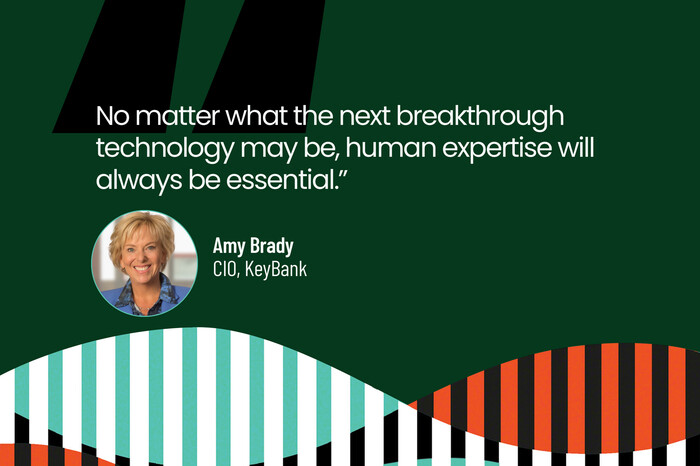
Brady: Technology will continue to radically transform every industry, but banks like Key will remain focused on building and leveraging AI to drive automation, personalization and client-centric experiences. No matter what the next breakthrough technology may be, human expertise will always be essential.
Our greatest opportunity in the coming year lies not only in Key’s continued investment in our people, but also in empowering our teams to invest in themselves through training and learning opportunities. This commitment enables us to challenge existing processes and achieve more — both personally and as a business.
Click the banner below to access exclusive artificial intelligence insights.
Kithulegoda: While technology accelerates progress, our approach remains rooted in relationships. Investments in branch expansion and workforce optimization ensure that digital and physical experiences work together to deliver meaningful value for our clients.
Venkatachari: All of our work in the past year, and particularly the past six months, has given us a lot more confidence. We have the right culture, the right people, the right processes in place — but there is a lot of work ahead of us.
And there is no pinnacle to reach. The target will continue to move as the technology evolves and drives changing client expectations. There will always be more to achieve, but we’re invigorated by the opportunities.