



May 08 2026
Artificial Intelligence

ServiceNow Knowledge 2026: Enterprises Look to Fast-Track Automation

Organizations are seeking speed, agility and productivity gains, and ServiceNow is answering the call as it embraces AI and agentic business to reduce enterprise burdens and workloads.

So much of the modern — and future — world of work is seeking accelerated paths. The arrival of AI, which promises lightning-fast responsiveness and seemingly limitless resources, seems like an easy button for speed. And while it’s true that AI and AI agents can accelerate processes and systems, achieving lasting and impactful efficiencies and automation requires serious intent, planning and strategy.

ServiceNow believes they’ve put that level of thought and thoroughness into its platform, and the conversation around how much they’re baking automation capabilities into current and future versions of ServiceNow was a consistent theme at Knowledge 2026 in Las Vegas. But fear not, that automation doesn’t mean relinquishing critical control or company context.

"Every capability I'm about to show you runs inside the policies, the permissions and the governance your organization already has in place. So, you get full visibility, full audit trail and full control,” said Kellie Romack, ServiceNow chief digital information officer, during the conference’s Day 2 keynote.

And Romack’s claims aren’t theoretical; they derive from ServiceNow eating its own dog food as it has labored to make its operations as autonomous as possible.

"At ServiceNow, 90% of our IT support requests are handled autonomously. That's what it means to go from roadmap to reality,” said Romack.

Click the banner below to learn more about integrating AI into your workflow.

Automation Improves as We Move From AI Agents to Agentic Workflows to AI Specialists

One significant aspect of developing the autonomous workforce actually comes from the rapid and ongoing revolution that’s happening with AI agents and automation. Although we’ve barely begun to wrap our heads around AI agents, ServiceNow leaders are already moving on to the next thing: AI specialists.

"These AI specialists are agents trained to do a specific job. They have defined goals, they're assigned to existing teams, and they execute workflows end to end,” said Romack. “Autonomous Workforce is possible because of everything we've shown you over the last two days, combined with all of the years of institutional knowledge already built into the platform. So, what you're activating is what you've already invested in."

If you’re wondering how we got from AI agents to AI specialists, it’s actually part of a three-year transition that ServiceNow has been tracking since 2024.
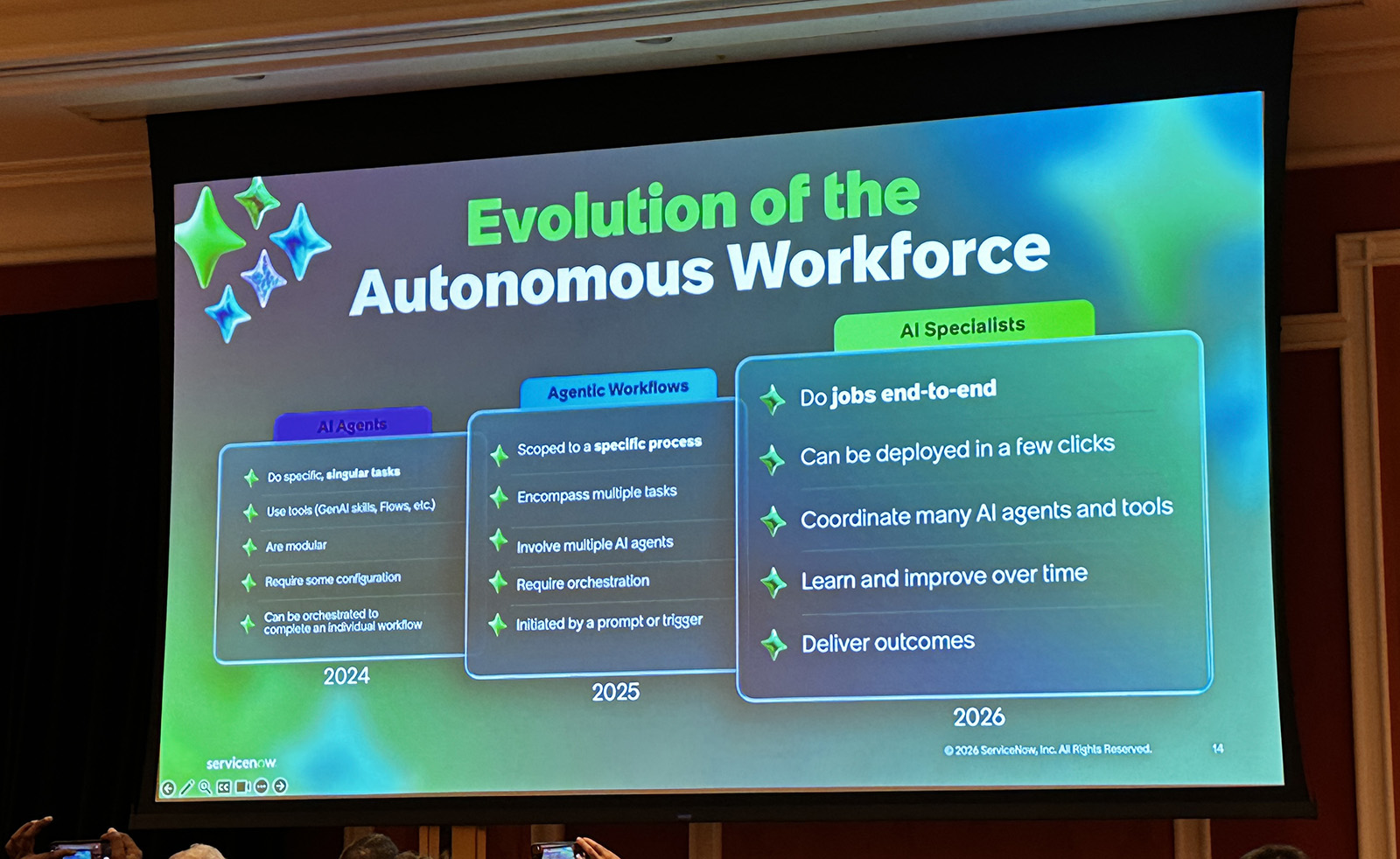
"If you remember way back to 2024, we launched AI agents. And this was a revolution at the time,” said Dan McCall, vice president of product management for ITSM at ServiceNow. “And AI agents are great at singular tasks. They use tools, and many of you have shown us today, actually, or throughout the show, how you've been able to use these in your own implementations, which has been wonderful.”

"Last year, we basically evolved into agentic workflows, and these can stitch agents together. They can do more advanced workflows, and they require that you initiate them either with a prompt or a trigger,” he continued.

Now we’ve arrived at AI specialists, which McCall sees as the most sophisticated and impactful manifestation of the autonomous workforce.

"We call these AI specialists,” said McCall. “And they do work end to end. They can be deployed in just a few clicks. They learn and improve over time and deliver full outcomes."

How Real Companies Are Experimenting and Reaping the Rewards of Automation

Companies of various stripes and sizes held sessions at Knowledge 2026 in which they shared case studies, success stories and lessons learned on a host of ServiceNow features and capabilities that leveraged automation to solve various business needs and challenges.

Boston Scientific, a global medical device company with operations in 130 countries and roughly 60,000 employees, was one that took the stage. The company was looking to simplify, scale and free up resources, as its service desk was responding to more than 1 million tickets and supporting nine languages. They thought AI and automation could be the answer they were looking for.

“We also wanted to have real-time assistance, like having faster answers for end users,” said Adriana Sanchez, director of global IT services delivery for Boston Scientific. “It was really important to have low-code/no-code included in that solution to have more power in AI without having to bring in a lot of people.”

Part of the key to implementing automation successfully lies in not viewing automation as an add-on to existing processes.

"AI automation [needs to be] embedded in the workflows,” said Sanchez. “So, it's how work gets created, not treating it as a separate thing but in the works. That made the platform a great choice for us."

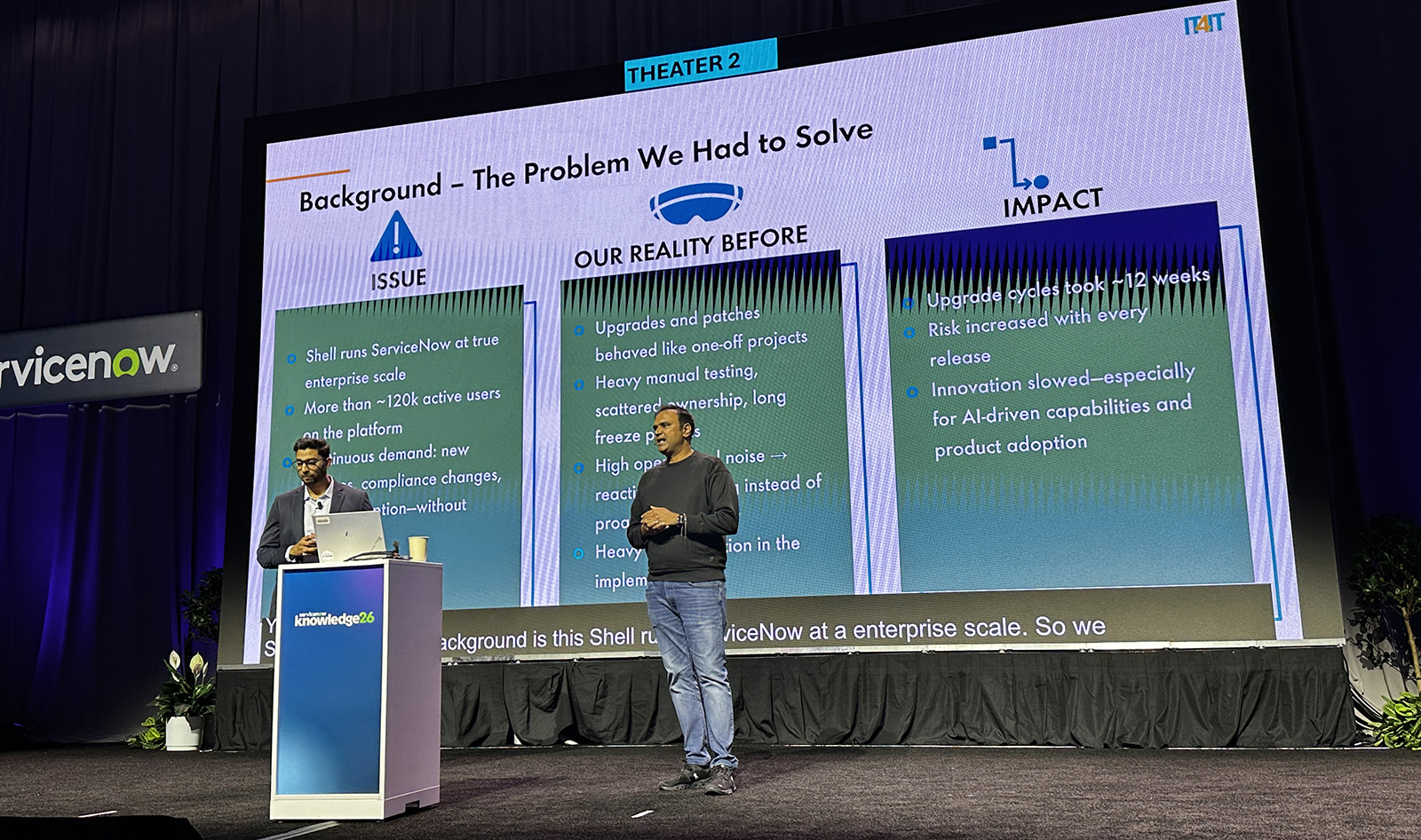
Sadiq Ameen, Chief Product Owner of the ServiceNow platform at Shell, and Rathish Dhayalan, Information Digital Technology Manager of the IT4IT team at Shell, shared their success with simplifying and automating the upgrade cycles for their ServiceNow instance at Knowledge 2026 in Las Vegas.


For Shell, a global group of energy and petrochemical companies employing around 96,000 people across more than 70 countries, the focus on efficiency and automation centered on speeding up the company’s upgrade cycles.

Previously, Shell’s instance of ServiceNow had an overwhelming number of customizations bolted on. Because they didn’t want to break these customizations, the company routinely skipped upgrade cycles. But it had to change course after it risked losing official support from ServiceNow as its version of the platform was being deprecated and would no longer be supported by the company.

That experience spurred Sadiq Ameen, chief product owner of the ServiceNow platform at Shell, and Rathish Dhayalan, information digital technology manager of the IT4IT team at Shell, to consolidate, simplify and accelerate the upgrade process holistically.

"We started off with way more customizations. The best strategy for customization is no customization,” said Dhayalan.

The answer was to get their instance of ServiceNow to be as close to out-of-the-box (OOTB) as possible. Here were the ambitions the Shell team shared during their Knowledge 2026 session:

  • Bring most — if not all — of modules closer to OOTB
  • Eliminate technical debt
  • Adopt industry best practices
  • Unlock faster upgrades
  • Make new features easy to consume

Following their tear down and rebuild of the platform, the company’s IT team reduced the time needed for ServiceNow upgrades to 6 weeks — consistently — year over year. And in 2025, they were able to pull off two upgrades in a single year, which was a first for the company.

“When you don’t skip upgrades, it reduces the time the of actual upgrade as well,” said Ameen.

And with simplicity and automation in place, what once required all-hands coordination has become, in Ameen's words, a silent upgrade — frictionless, low-drama and repeatable.

Bookmark our Knowledge 2026 conference coverage page to keep up with all of the articles and videos that we’ll be sharing.

Photography by Ricky Ribeiro
Close

New Research from CDW on Workplace Friction

Learn how IT leaders are working to build a frictionless enterprise.