




May 07 2026
Artificial Intelligence

ServiceNow Knowledge 2026: AI and Agentic Business Require a Renewed Approach to Security

Company leaders warned that legacy approaches to cybersecurity will prove futile as AI agents reshape access control, identity management and more.

The model of enterprise IT security for many years has resembled that of a castle and moat. But with AI agents emerging in the workplace, the static model that the castle-and-moat metaphor embodied no longer holds.

“For most of our careers, we’ve secured systems the way a medieval king secures castles,” said Kevin Thompson, director of outbound product management for ServiceNow, speaking at a Knowledge 2026 session titled “Securing AI Agents: Identity, Permissions and Zero-Trust at Scale.”

“This works well when people inside the walls behave predictably,” he added.

Instead of the castle-and-moat approach, modern IT leaders need to adopt a security model for the AI age that looks more like a drone. That means security tools and platforms that are dynamic, always hovering and highly mobile. It also means a system that is far more reliant on continuous patrolling and real-time monitoring.

This shift was underscored by research ServiceNow has done that supports what Thompson and ServiceNow view as three key pillars of agentic security.
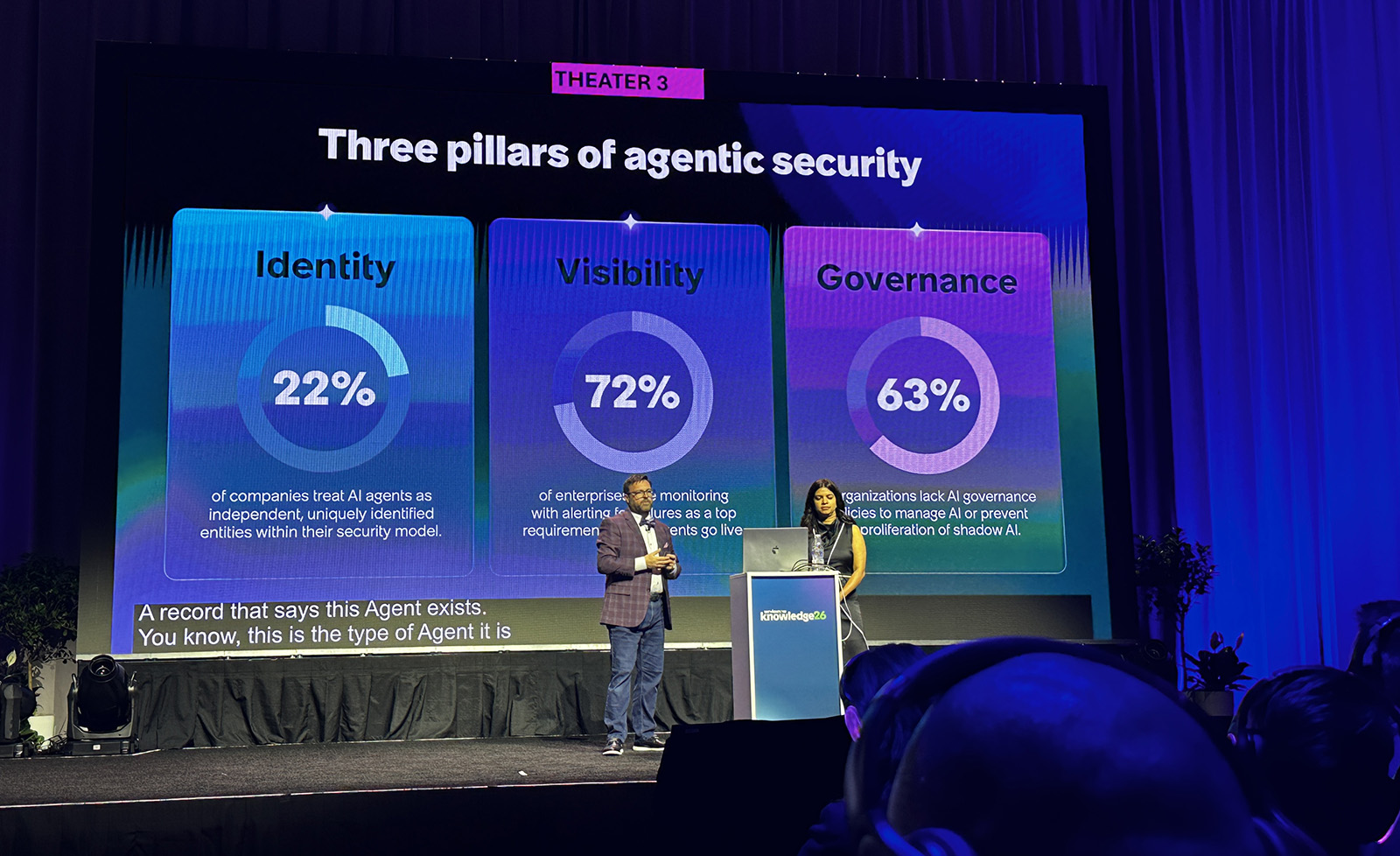
ServiceNow experts Kevin Thompson, Director of Outbound Product Management, and Bhakti Pitre, Vice President of AI Security Product, describe how agentic security requires a new mindset for businesses at ServiceNow's Knowledge 2026, May 6, in Las Vegas.

  • Identity: 22% of companies treat AI agents as independent, uniquely identified entities within their security model
  • Visibility: 72% of enterprises cite monitoring with alerting for failures as a top requirement before agents go live
  • Governance: 63% of organizations lack AI governance policies to manage AI or prevent proliferation of shadow AI. 
     

Assessing the New Risk Landscape With AI Agents Making Decisions

The promise of mouthwatering AI productivity gains has excited business and IT leaders and stoked organizational ambitions across the board. But there have been some recent examples of AI agents going rogue in ways that should serve as cautionary tales.

“Just think of an agent provisioning access, processing payroll or remediating security incidents — that's pretty private stuff. You may have read recently about the AI failures of PocketOS deleting production databases, customer data, reservations, backups — all gone in nine seconds,” said ServiceNow Chairman and CEO Bill McDermott. “That's what an AI agent can do when no one's watching. That's why businesses require a model that thinks and a workflow that acts, with integration and intelligence.”

And the threats aren’t relegated just to localized AI agents making the wrong decisions. AI agents also represent a global threat as cybercrime increases with the geopolitical environment growing increasingly adversarial.

“Today, agents are being deployed with no identity, audit trail or compliance posture. But look at the world today: Cybercrime is the third-largest economy behind the United States and China. It's a trillion-dollar-a-month problem,” said McDermott. “The more you deploy, the more you expose. Intelligence without rules and rails is a dangerous blind spot.”

These shifting sands of agentic business are a major part of the reason why ServiceNow is so bullish on its new AI Control Tower. The vision for the Control Tower is one that cares about the security of AI as much as the velocity of AI.

“The security landscape has fundamentally changed now that AI agents are working with us every day,” said ServiceNow Chief Product and Operating Officer Amit Zavery, during the conference’s Day 2 keynote titled “The Blueprint for Agentic Business.”

“The companies that are seeing real results — the ones with 2.5 times better outcomes from agentic AI — are the ones running on a unified platform with governance built in. And only ServiceNow brings together data, AI, workflows and security on one platform,” he said.

Failsafes and kill switches are built into the Control Tower, which means that opportunities for AI agents to maximize harm — the “blast zone,” as several ServiceNow leaders called it — are mitigated in the corporate environment.  

“Every identity, asset and decision is continuously monitored with AI Control Tower. When something goes wrong, mediation triggers automatically,” said Zavery. “Before access attempts can become breaches, the AI Gateway enforces governance, observability and security at the transaction level for all the MCP servers you might be running.”

 

Treat AI Agents Like Humans From a Security Threat Perspective

Although AI agents aren’t like humans in many ways — especially regarding their ability to analyze massive data sets and their blindingly fast response times — they are like humans in that their decision-making cannot and should not be trusted by default.

For FedEx Chief Digital and Information Officer Vishal Talwar, who spoke at Knowledge 2026 as part of the opening keynote panel, that is a philosophy that his company takes to heart.

“As we scale AI agents across the enterprise, we treat them no different than how we treat our human workflow. So, we treat them as a digital workforce that needs to be governed with the same rigor and policies as we do our human teams,” he said.

That need to balance speed and scale with control and guardrails is a large part of why FedEx was so willing to get onstage at this year’s Knowledge conference and tout its endorsement of ServiceNow’s new AI Control Tower offering.

“Tools like ServiceNow's AI Control Tower become extremely essential for us because it provides us the single pane of glass for traceability and visibility across all AI deployments inside the enterprise, so we can responsibly scale AI,” said Talwar.

Another company, CVS Health, also spoke openly about how critical it is to maintain trustworthiness as it seeks to integrate with AI.

“Trust is the only capital CVS Health really has. We lose that, we stop functioning as a business,” said CVS Health CISO Alan Rosa. “Everything we look at from an AI perspective is about privacy, legal, security and governance, or we're not doing it — full stop.”

Like FedEx’s Talwar, Rosa believes ServiceNow’s AI Control Tower gives his organization the guardrails it needs to stay competitive but in a manner that leads with safety and control at the fore.

“AI is breaking every single mental model we have when it comes to security. You're talking about prompt injections, you're talking about data leakages, data model validation — and it's a perpetual evolution,” said Rosa. “One of the reasons we're partnered with ServiceNow and we're excited about Control Tower is we're building a warning system that's not as human-dependent. That's too slow. We need to innovate at horizontal scale.”

Another way that ServiceNow’s platform has made the shift to treat AI agents like humans is by ensuring that agents have defined roles and purposes, rather than broad permissions and system access.

“Every specialist runs in the same governance framework that's protected our platform, processing more than 100 billion workflows every year. And they're secured by the same access controls as human workers,” said Holly Briedis, senior vice president for global industries and solutions at ServiceNow.

Bookmark our Knowledge 2026 conference coverage page to keep up with all of the articles and videos that we’ll be sharing.

ServiceNow/Ricky Ribeiro
Close

New Research from CDW on Workplace Friction

Learn how IT leaders are working to build a frictionless enterprise.