General Fasteners, a 75-year-old small business based in Livonia, Mich., has evolved significantly in the past few years from a supplier of fasteners, washers and other hardware into a provider of vendor-managed inventory, engineering and logistics services.
In 2025, the company rebranded as GF to reflect those changes and has experienced rapid growth, opening new warehouses in Texas and Washington state, two locations in Mexico and another in Montreal.
GF supports military, automotive, heavy truck, industrial and medical customers. That diverse customer base, along with the company’s rapid expansion, brought it to a point where it needed to harden its infrastructure, says Jimmie Jefferson, GF’s senior manager of IT infrastructure and cybersecurity. GF streamlined its cybersecurity tools and took a platformization approach using Microsoft tools and solutions from other vendors.
Click the banner below to get small business insights delivered to your inbox weekly.
“It was too difficult to maintain cohesive security across the disconnected platforms, and it became clear to us that Microsoft’s centralized platform was essential to ensuring our ongoing security,” says Seth Burk, GF’s IT director.
Increasingly, small and medium-sized businesses use security platformization to consolidate tools onto holistic cybersecurity platforms, says Frank Dickson, group vice president for IDC’s security and trust research practice. Done properly, the approach allows SMBs to gain unified visibility of security telemetry across all environments, centralize policies and management and achieve operational efficiencies that free time for IT security teams.
“Moving forward, platformization for a smaller company isn’t a nice-to-have, it’s a have-to-have,” Dickson says. “Given the exponential increases in IT complexity, we can’t layer security tool complexity on top of that.”
DISCOVER: The cybersecurity solutions and services that can help your business.
GF Embraces Microsoft’s Security Platform
Because of the industries GF serves, the company must comply with numerous security and regulatory frameworks, including the Trusted Information Security Assessment Exchange. As GF took on more customers that brought increasingly rigorous cybersecurity expectations, it recognized that a standardized and governable technology environment would better support security operations as well as long-term compliance objectives. “We just hit a line in the sand,” Burk says.
GF started reducing the number of disconnected security and management platforms it relied on in July 2024, first by standardizing core security functions around Microsoft’s platform. The company then adopted M365 licensing, Microsoft Defender for Endpoint, Microsoft Defender for Office 365 and Microsoft Intune. The streamlining made it easier for GF’s IT team to monitor telemetry and alerts across email, identity, endpoints, networking and more.
“Technology should enable the business, not slow it down. Our goal wasn’t simply to replace products — it was to build a security and infrastructure foundation that could support GF’s growth without adding more complexity every time we opened a new location or onboarded a new customer,” Jefferson says. “By standardizing our environment, we’ve been able to spend less time maintaining technology and more time helping the business move faster while meeting the security and compliance expectations of our customers.”
The shift improved integration and single sign-on capabilities while allowing tighter device management and faster user onboarding.
TAKE ACTION: Find out how mature your security posture is with a self-assessment.
GF partnered with CDW to roll out the platformization approach as well as ongoing managed services and security monitoring. The relationship is a collaborative one when it comes to security management and planning, Jefferson says. CDW helps with monitoring, creating rules and even acting on policy violations.
“They’re a force multiplier,” Burk says. “They shoulder a lot of the noise work.”
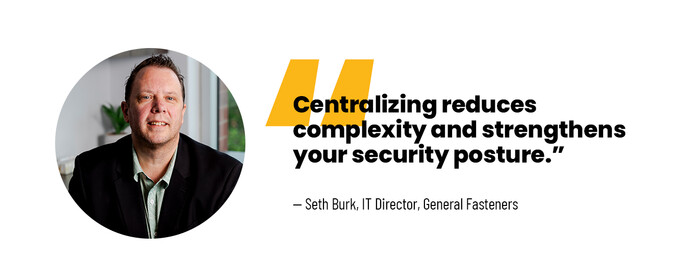
Platformization was the right approach for GF, Burk says, and it may make sense for other SMBs, because complexity tends to compound over time. “The more disconnected systems, vendors, identities and tools you maintain, the harder it becomes to support everybody,” Burk says. “Centralizing reduces complexity and strengthens your security posture, improves governance and makes the environment easier to support and manage.”
Addition Financial Gains Efficiencies Through Platformization
Addition Financial Credit Union, a member-owned credit union based in Lake Mary, Fla., adopted security platformization after significant expansions over the past decade brought more than $4 billion in member assets under its management.
Although the organization operates with a lean IT security team, its paramount concern is maintaining member trust, says Matt Walsh, the credit union’s senior vice president of IT.
During Walsh’s eight years with Addition Financial, the company has seen various cybersecurity transitions. Until a few years ago, the industry focused on providing organizations with telemetry from all the systems users interacted with, including email, identity management and endpoint security.
“That typically came through disparate systems rather than a consolidated platform,” Walsh explains, which led to a lot of alert fatigue.
“We were successful in getting all of the information in front of the analysts, but our emphasis has now shifted to getting the analysts focused on what’s important,” he says.
Addition Financial had been using the Falcon platform from CrowdStrike for endpoint security but relied on a different vendor’s solution for managed detection and response. In 2024, the company consolidated tools and adopted CrowdStrike’s Falcon Complete Next-Gen MDR. The shift meant telemetry could be funneled to one platform that allowed Addition Financial’s IT team to see, correlate and analyze information in near real time, Walsh says.
The credit union has also gained efficiency in endpoint security, cutting the amount of time spent triaging alerts in half, Walsh says. It partners with the CrowdStrike Complete team to monitor “most of the noise to make sure we get eyes on the things that are truly important,” Walsh says. This allows Addition Financial’s IT staff to bring internal knowledge of its environment to bear as they weigh important alerts.
The consolidation and efficiencies gained through managed services allow the IT team to focus on priorities to improve the credit union’s security posture. Platformization works for several reasons; first, by providing enhanced risk management and lower total cost of ownership. The approach also improves the team’s ability to meet and maintain compliance with National Credit Union Administration requirements.
The streamlined setup helped Addition Financial shift from “whack-a-mole to only looking at the things that really matter,” Walsh says. “We can focus our time on continuously -improving our security posture.”
Click the banner below to read the recent CDW Cybersecurity Research Report.
A Smart Small Business Approach to Platformization
Organizations considering security platformization should ensure they’re moving to a platform and not just adopting a collection of features, IDC’s Dickson advises.
He shared several characteristics IT leaders should keep in mind when choosing a solution: unified telemetry and shared data model; centralized policy and management; integrated analytics and threat intelligence; automation and orchestration capabilities; an integrated response across multiple control planes; and operational simplification. Businesses typically make platformization shifts incrementally, perhaps adding new features to a core element of the security stack.
A proof of concept will reveal how difficult or how easy it will be to consolidate, Dickson says.
And, says Jefferson, SMBs should take a deliberate approach by shopping around before deciding to consolidate.
Platformization is not a magic bullet that will solve all security issues, Walsh adds: “Implementing these tools creates potential, and the only way you’re going to realize that potential is through continuous improvement."