At the same time, AI is also improving cybersecurity tools. Vendors across the industry are using AI for anomaly detection, event correlation and other defensive capabilities. We do the same in our own products.
But overall, the risk level for enterprises has still increased. Even though defenses are improving, the attack surface is growing, and attackers are becoming more efficient.
BIZTECH: How are organizations using AI on the resilience side to defend against these threats?
The first principle is accepting that breaches will happen. You have to assume compromise and design your environment around recovery. One key element is immutable backups. Organizations need backups that attackers can’t alter or delete. In addition to storage-level immutability, we also use techniques like air-gapping, where data is moved into a separate tenant that we manage. That way, even if a cloud subscription is compromised or accidentally deleted, the data remains safely vaulted.
Another major challenge is ensuring that backups themselves are clean. Attackers often plant malware long before launching a ransomware attack. Customers frequently ask, “How do I know my backups aren’t already compromised?”
DISCOVER: Connect on-premises and cloud systems into a unified, high-performing platform.
To address that, we use a combination of signals. We look for anomalies in backup behavior; for example, sudden spikes in file changes or data size. We analyze encryption signatures that could indicate ransomware activity. And we perform deep malware scanning to identify malicious code.
We also correlate those signals with data from partners such as Palo Alto Networks, CrowdStrike and other security providers. That gives us a more comprehensive view of what’s happening across the environment.
AI plays a role throughout this process. It helps with automated event correlation, identifying anomalies and generating recommendations. For example, if the system detects a problem, it might recommend restoring data into a clean-room environment — a sandbox where organizations can safely analyze the data before returning it to production.
BIZTECH: Despite all these changes, what fundamental challenges around cloud and security remain the same?
I think of these challenges in three categories: technical, economic and operational.
First, data fragmentation continues to increase. Data is growing at roughly 40% per year. Large enterprises may have a dozen or more data warehouses and dozens of Software as a Service applications. As organizations adopt more services and platforms, their data becomes more distributed, which makes visibility and protection more difficult.
Second, data gravity remains a major constraint. Even if AI makes it easier to write scripts or manage applications across clouds, moving massive amounts of data between clouds is still expensive and time-consuming. If you have petabytes — or even exabytes — of data in a particular cloud environment, you can’t simply relocate it whenever you want.
RELATED: Unify data protection across your hybrid infrastructure.
Third, there’s the operational challenge. Managing cloud environments — and especially multicloud environments — is fundamentally an organizational problem.
There’s a well-known framework for AI adoption: 10% of the challenge is algorithms, 20% is the surrounding technology, such as data and infrastructure, and 70% is people and operating model. Organizations need to retrain staff, redesign processes and rethink compliance, governance and risk management.
That’s often the biggest barrier to AI adoption. Technologically, the tools are available. But companies still have to rewire how they work. For example, if a software company starts using AI for coding, it can’t just deploy the tool. It also has to rethink security reviews, quality testing, development workflows and risk management. Those operational changes take time.
BIZTECH: What advice do you give organizations trying to prepare for this faster, AI-driven environment?
The key message we share with customers is that a lot is changing very quickly. Organizations need to adopt new technologies, but they also need to rethink their operating models. As innovation cycles accelerate, things will inevitably break. Your ability to adopt AI confidently depends on your resilience posture — your ability to recover quickly when something goes wrong.
That means rethinking security and resilience strategies for an AI-first world. The tools and frameworks that worked in the past won’t necessarily be sufficient going forward. This is one of those invisible factors that directly affects how quickly a company can innovate. If you have strong resilience, you can move faster because you know you can recover if something fails.
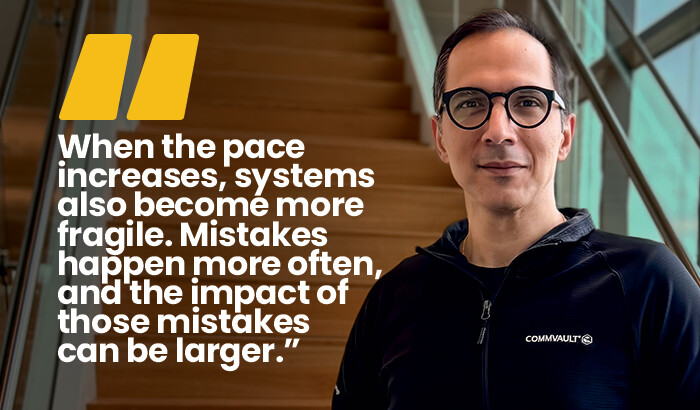
And failures won’t always be malicious. Systems might break because of human error, because an AI agent makes a mistake or even because a model hallucinates. As the pace of change increases, the overall level of risk increases as well. So, if organizations want to move faster while still managing risk, they need to rethink their resilience strategy.