FedEx Goes All in With ServiceNow, Enterprise AI at Scale
As more businesses have embarked further into the digital age, it has meant a move away from the physical realm in many instances. But for FedEx, which like many logistics companies has seen a boom in business as e-commerce has become more common, digital technology will always be the supporting character in its world as packages, people and products remain central to its mission.
“On a daily basis, we move 18 million packages around the world, passing [through] 220 countries and territories. This means working together across our global network to find the best routes and the most efficient processes,” said Vishal Talwar, chief digital and information officer for FedEx.
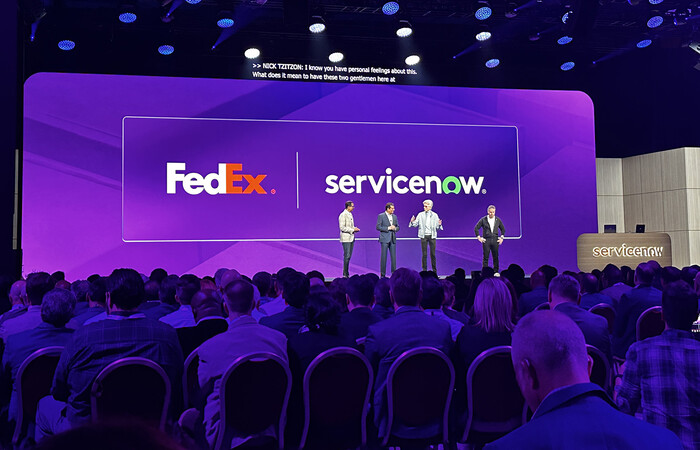
McDermott brought out FedEx during the opening keynote at Knowledge 2026 to impart lessons learned from the company’s journey with ServiceNow and enterprise AI.
But just because the business remains rooted in the physical world, that doesn’t mean that digital technology and AI can’t improve how things work.
“If you think about the global supply chain, there’s a lot of inefficiency. There’s $1.8 trillion of inefficiency in global supply chains, and we want to move up that value chain to orchestrate global supply chains, even if it moves outside of FedEx,” said FedEx CEO Raj Subramaniam.
READ MORE: Four ways manufacturers can protect their supply chains from cyberthreats.
The logistics company has embraced ServiceNow’s vision of enterprise AI that is interconnected and scalable, but done in a responsible, secure and trustworthy manner.
“We’re leveraging ServiceNow’s capabilities to help us build a digital backbone on how we run as an enterprise across finance, HR, legal, across procurement and technology. We execute 5 million ServiceNow workflows across three critical processes: hire-to-retire, service-to-pay and ship-to-collect. With ServiceNow, we are building an AI Control Tower to make sure that we responsibly introduce this capability inside our environment,” said Talwar.
While startups can get away with a “move fast and break things” mindset, that’s not a philosophy that works for FedEx — or for many large, established enterprises. The trust that customers place in its reliability and accuracy are core tenets of its value proposition that a sloppy implementation of enterprise AI could erode.
“For a company like FedEx, where our brand has been synonymous with trust for the last 50 years, there is no room for error,” said Talwar. “As we undergo our digital transformation to make supply chains smarter for everyone, as Raj just highlighted, we’re ensuring that trust and security is engineered into every facet of this transformation from the start.”
The experience of further integrations with digital transformation and enterprise AI have forged a deep, connective bond between the two leaders at FedEx, underscoring just how influential IT leaders are becoming in business decision-making.
“I think the role of any business is technology, and technology is business. So, whenever we talk about any strategic thing, especially in the world of FedEx and where we are headed now, the CDIO, and Vashal [Talwar] in particular, is my thought partner; he’s my strategic partner from a business-angle point of view,” said Subramaniam.