When Precision Cable Assemblies began migrating its enterprise resource planning system to Microsoft Azure, company leaders had clear goals in mind. They wanted to reduce long-term infrastructure costs, modernize their operations and better support sales staff.
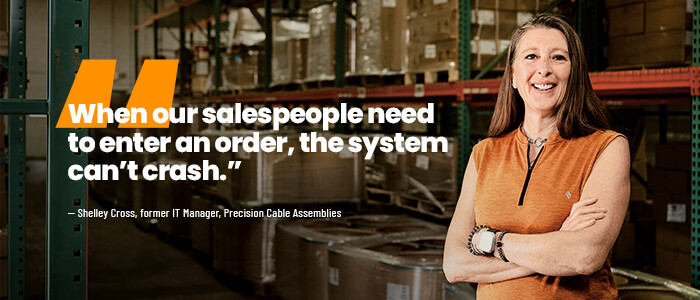
“This is a mission-critical application,” says Shelley Cross, PCA’s IT manager at the time of the migration. “It touches our inventory, our financials — it’s the driving force of the company. When our salespeople need to enter an order, we can’t have the system crash.”
However, the company hit a number of hiccups during its path to the cloud, before finally settling on a partner and an architecture that helped it meet its goals. That experience is common for small and medium-sized businesses navigating complex cloud journeys. While cloud adoption is often driven by benefits like scalability, cost optimization and enhanced security, the path is rarely straightforward, especially for organizations with limited IT resources. And according to the 2025 State of the Cloud Report from Flexera, 75% of organizations cite a lack of resources or expertise as a top cloud challenge.
“The cloud is not a panacea,” says Eric Hanselman, chief analyst at S&P Global Market Intelligence. “The problem for most small and midsized businesses is that they may not be as familiar with the limitations and the stumbling blocks. Those can be as simple as: Is there support for the database in my back end? Am I simply moving an existing application with its current architecture, and can the cloud provider support that? And how do I size the environment to avoid sticker shock? These are fundamental questions, and the answers can be complicated.”
Click the banner below to read the full 2024 CDW Cloud Computing Research Report.
PCA Got Expert Help Clearing Cloud Hurdles
Headquartered in Brookfield, Wis., PCA produces wire harnesses for a wide range of industries, including products for construction and agricultural machinery, as well as for marine and emergency vehicles. Cross joined the company when it was already midway through its cloud journey.
PCA had relied on the help of partners for both expertise and added capacity. The organization has fewer than five full-time IT staff to support both PCA and sister company Global Engineered Products, and infrastructure decisions have the potential to impact business productivity. However, the in-progress Azure build was experiencing a number of problems when Cross joined the company.
Virtual machines were shutting down unexpectedly, sometimes bringing down unrelated applications with them. Also, the Azure environment lacked basic security protections, with public-facing servers vulnerable to external threats. And overall, the build was failing to provide the seamless integration between cloud and on-premises resources that PCA wanted.
84%
The portion of organizations that cite managing cloud spending as a top cloud challenge, more than any other factor
Source: Flexera, 2025 State of the Cloud Report, March 19, 2025
“Nobody could get into our file server,” Cross recalls. “We had 125 users for one Remote Desktop Protocol server, and we didn’t even have a load balancer.”
Cross had worked with CDW in previous roles, and she brought the organization on board as a partner to get PCA’s Azure initiative back on track. CDW immediately introduced new security features such as firewall rules, VPN access, multifactor authentication and detailed patching schedules. CDW also implemented monitoring tools that gave Cross and her team clear visibility into system health, licensing and update cycles — insight that the company previously lacked. To solve the architecture problems of the in-progress cloud environment, CDW built out a new hub-and-spoke Azure architecture that featured hybrid connectivity to improve reliability and performance.
Within just a few months, PCA was able to go live with its new Azure environment. “We are light-years ahead of where we were before,” Cross says. “I don’t hear the complaints that I used to hear. The build is far more stable, and CDW is actively monitoring and managing our environment.”
Click the banner below for a more detailed explanation of how to optimize FinOps.
When a Lift-and-Shift Isn’t Good Enough
Brain Corp is a San Diego-based autonomous technology company that develops robotic and AI solutions to automate cleaning and inventory tasks in environments such as retail stores, schools and warehouses. Several years ago, the company set out to switch hosting for its BrainOS software platform from another public cloud provider to Google Cloud.
But rather than simply migrating resources from one cloud environment to another, the company opted to rewrite almost its entire code base from scratch.
“Robots are essentially giant Internet of Things devices,” says John Gill, vice president of engineering at Brain Corp. “They generate a ton of data, and the architecture that we had built in our previous cloud environment was not adequate for where we saw the future going. We wanted more real-time data uploads, more real-time data streaming. Rather than doing a lift-and-shift or move-and-improve, we went back to ground zero and redesigned everything.”
The move was attractive for several reasons. For one, Brain Corp leaders were impressed by Google’s services and security offerings, and the environment allowed the company to do more to isolate customer data — even down to the level of individual robots. The move also set the stage for Brain Corp’s future products to leverage Google’s Gemini large language model after its public release, which let Brain Corp engineers use AI to write the new code more quickly. Also, the migration gave Brain Corp the chance to improve its code base to meet its evolving goals.
“As is often the case with startups, the business needed to stay agile and pivot quickly. In the process, we were left with legacy code that no longer aligned with our current business model,” says Krystal Mattich, senior director of data and business systems.
“Brain Corp completed around 80% of its migration in 18 months, with most long-tail details completed at around the two-year mark,” Gill says. “Because the BrainOS software is a key component of the company’s products, the team had to diligently test to make sure that the migration would not have a negative impact on the customer experience.”
The move cut the company’s robot-support infrastructure costs by 60%, accelerated the development of new services and sped up software updates by a factor of six.
Gill and Mattich attribute much of the success of the move to buy-in among Brain Corp executives, as well as extensive use of Google’s native services like Google Kubernetes Engine and the BigQuery AI data platform.
Brain Corp kept the migration on track by tackling problems as they arose. “It’s so easy to say, ‘This isn’t working, we’re going to roll back to last known,’” Gill says. “That tendency can cause projects to stagnate. We decided, instead of rolling back, we were going to roll forward and figure it out.”