Dec 01 2025
Digital Workspace

Museums Deploy Interactive Technology To Create More Immersive Experiences

The Griffin Museum of Science and Industry and other science centers are integrating projectors, touch screens and other technology to enhance the visitor experience.

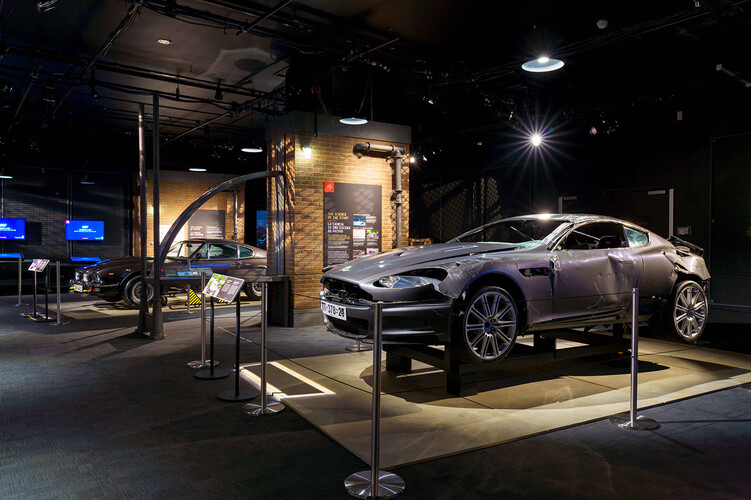
For a year, fans of film and international espionage stepped into the world of James Bond at Chicago’s Griffin Museum of Science and Industry, where they explored 007’s stylish cars equipped with flamethrowers, ejector seats and submarine capabilities. One impressive attraction was the damaged Aston Martin DBS that set a Guinness World Record for surviving seven barrel rolls in the 2006 Bond film Casino Royale.

TV displays and projection screens showed related movie scenes alongside each Bond vehicle on display. Visitors could witness actor Daniel Craig’s crash sequence while inspecting the wrecked car.

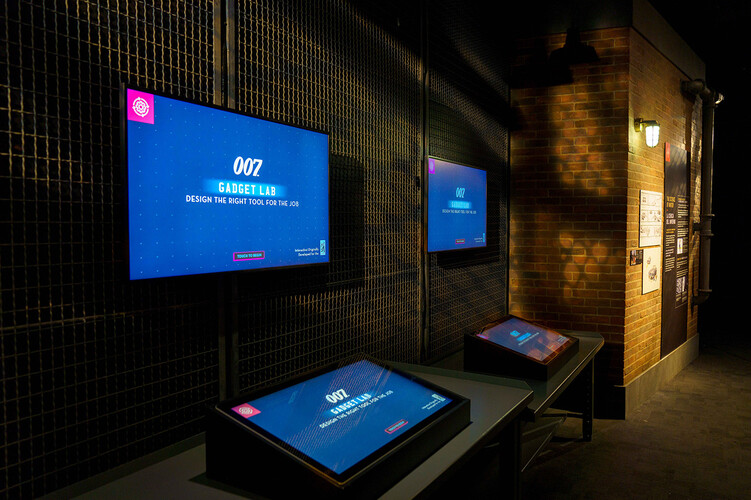
The exhibit also featured interactive experiences, powered by PCs and touch screens, that let museumgoers build spy cars, create gadgets and design stunts, then test whether their designs would work in simulated missions.

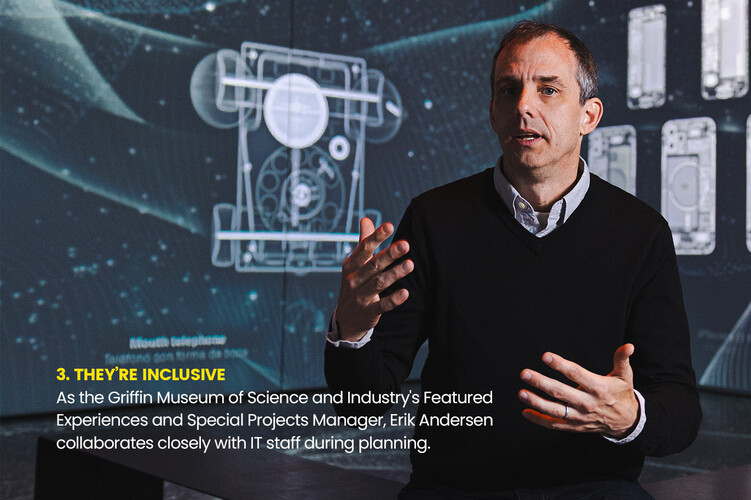
“We wanted them to make decisions, to feel like they were agents within the world of James Bond,” says Erik Andersen, Griffin MSI’s featured experiences and special projects manager.

Click the banner below to freshen up your customer experience strategy.


How Technology Is Changing Public Exhibitions

Nonprofit museums, science centers and other public attractions are increasingly infusing technology into exhibits to enliven visitor experiences and provide more immersive multimedia activities.

“People’s expectations for interactivity have gone up tremendously over the past few decades, especially for kids who are exposed to electronics everywhere,” says Bob O’Donnell, president and chief analyst at TECHnalysis Research.

Museums leverage off-the-shelf technology. Instead of static images, people can learn more effectively when they see movies or animation showing how things work. They are also using physical components such as gears, actuators and robotics.

“That can tremendously change how people understand something,” O’Donnell says. “These technologies allow exhibits to come to life and make them more intuitive and engaging.”

At Griffin MSI, the James Bond exhibit invited visitors to explore the science, technology and engineering behind the spy franchise, including how fictional gadgets inspired real-world espionage innovations. The “007 Science: Inventing the World of James Bond” exhibit featured 13 vehicles and over 90 artifacts spanning all 26 Bond films, including the jet pack from Thunderball.

Instead of simply displaying movie memorabilia, the museum deployed interactive touch-screen displays, Windows PCs and Epson projectors from CDW to create engaging experiences across the 13,000-square-foot, two-gallery exhibit, which ran from March 2024 through April 2025.

How Museums Use Tech To Educate the Public

Museum staff purposefully made the Bond exhibit more tech-heavy than past exhibits, Andersen says: “James Bond is very sleek and technologically innovative, so we wanted to have ways to present that to guests.”

The museum’s education department collaborated with exhibit developers to identify the science and physics behind Bond’s gadgets and stunts, then integrated those throughout the exhibit to meet the museum’s educational mission, Andersen says.

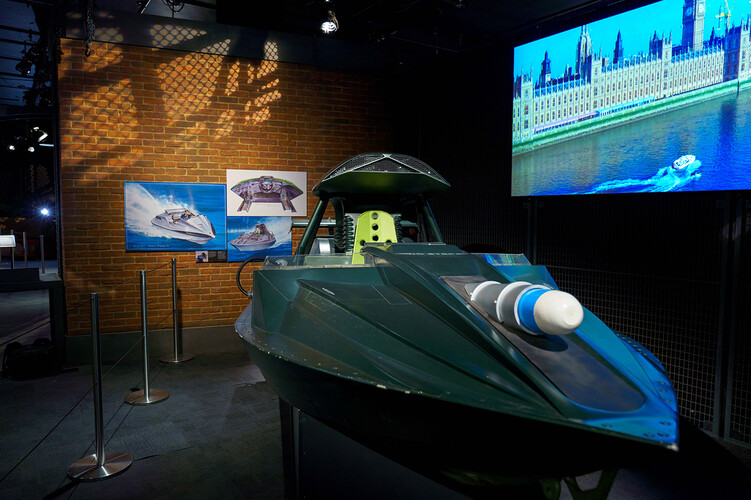
About a dozen ceiling-mounted Epson projectors with short-throw lenses displayed movie clips that demonstrate how vehicles and gadgets functioned, such as the Q Boat with torpedo launchers and rear jet thrusters that Bond piloted across the River Thames in 1999’s The World is Not Enough.

“Showing the movie clips was important because it puts the artifact in context and really elevates it,” he says.

Interactive exhibit stations offered more hands-on experiences, challenging museumgoers to outfit Bond cars with mission-specific gadgets such as ejector seats. A second interactive experience allowed guests to create spy equipment for espionage scenarios.

A third interactive exhibit allowed people to design stunts by adjusting variables such as car speed, ramp height and angle, then watch through animation whether their designs succeeded. Each exhibit featured multiple 32-inch ELO touch screens powered by PCs.

Most PCs for the interactive stations were housed in server racks located in technology closets. Some attractions, including an interactive digital shark tank, required local PCs positioned nearby.

To highlight Bond’s escape abilities, the shark tank interactive re-created the Thunderball scene in which Bond escapes a shark-filled pool. When visitors touched a 98-inch ViewSonic touch-screen display, a shark charged and appeared to crack the screen. 

“The shark jumps at you,” Andersen says. “It’s a bit of a jump scare, and some people love it.”

Now that the Bond exhibit is over, Griffin MSI has repurposed some of the technology into other exhibits. Overall, technology fundamentally changes the museum experience, he says:

“Technology creates an experience that allows for flexibility. It’s different than reading panels. Getting guests engaged by letting them make decisions on an interactive display conveys content in a unique way.”

RELATED: See the nonprofit IT solutions and services that can accelerate your mission.

How Franklin Institute Modernized With Tech

In Philadelphia, the Franklin Institute wanted to modernize its older exhibits, including some dating back 20 years. To build digital and interactive experiences in a 1930s building, it began upgrading its network infrastructure two years ago by adding cabling and HPE Aruba network switches throughout.   

“We needed to create an infrastructure across the building, from a data and electrical perspective, to modernize these exhibits,” says Abby Bysshe, the museum’s chief experience and strategy officer.  

With new network infrastructure, the institute is upgrading a major exhibit every year, integrating touch screens, motion-capture systems, infrared sensors and robotics to create engaging, interactive activities.  

“For us, interactivity is key. That’s the ethos of how we present our storytelling,” she says. “We want people to experiment and have more hands-on experiences. We find those to be much more memorable.” 

In 2023, it opened the 7,500-square-foot Wondrous Space exhibit on space exploration, followed in 2024 by Body Odyssey, an 8,500-square-foot exhibit on the human body. Both $8.5 million exhibits are designed to look and feel more like theme park entertainment attractions than traditional educational museum displays.

To match each exhibit’s theme, the Franklin Institute designed some interactive experiences with circular and oval-shaped screens. The custom look was created by mounting rectangular TV displays behind custom display panels with circular cutouts.

One Body Odyssey interactive experience allows visitors to stand in front of three 98-inch oval-shaped displays. Motion-capture cameras track their movements in real-time. When they move, Simply NUC computers process their movements, so they can see depictions of their skeletal, circulatory and muscular systems move along with them on the individual screens.

“It’s a great personal experience, as opposed to just having a standard body outline that doesn’t match yours,” Bysshe says.

In the space exhibit, the institute modernized its classic gravity well demonstration by adding a motion-capture camera and a Barco projector. The projector displays colored light trails tracking the balls’ orbital paths and creates visual splash effects when they collide. The updated experience uses a BrightSign media player, Shuttle kiosk PC and an LCD display.

 “The extra layer of technology improves upon an already classic science center experience,” she says.

With these technology upgrades, the institute can better compete and attract more visitors and update exhibit content more easily, Bysshe says.

“From an experience and content perspective, it gives us the ability to stay fresh and relevant,” she says.

Click the banner below to learn how enterprises are unlocking artificial intelligence’s potential.


Silicon Valley Museum Demystifies Technology

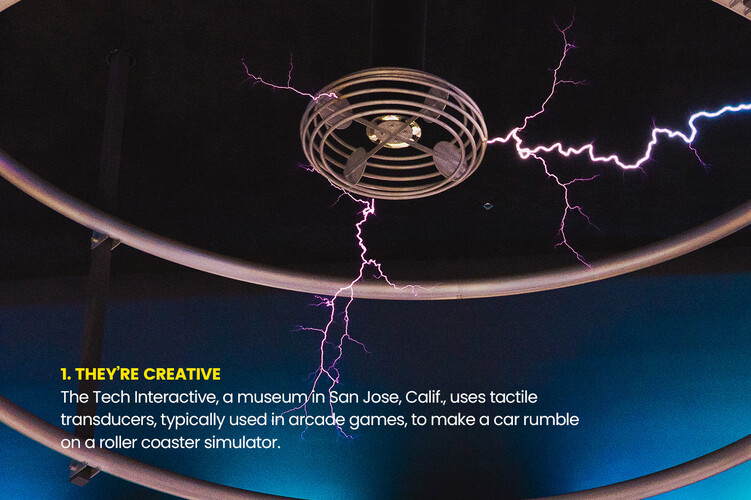
Technology is the central focus of The Tech Interactive’s educational mission. As such, the staff does not hide the technology behind its exhibits.

Projectors hang visibly from the ceiling. Mechanical components are exposed. Computers and cabling are also in plain sight.

“We’re not trying to make people think things are magic. It’s science and technology, and we want to demystify it,” says Erica Barrueto, vice president of exhibits for the San Jose, Calif., museum. 

The Sustainable Cities exhibit combines physical and digital elements to teach urban planning concepts through a room-sized model of six Bay Area cities. Using Elo touch screens, people make choices about energy sources, transportation mixes, housing density and green space while trying to achieve a 100% sustainability score. 

As guests adjust percentages between mixed-use buildings and single-family homes, motorized actuators raise and lower 3D-printed buildings. Projectors display changing graphics on the model cities, showing traffic patterns based on the mix of cars, mass transit and bike lanes. 

The exhibit’s technology remains visible: computers running software, projectors overhead and actuators under the table. “People can see those pieces and understand how it works,” Barrueto says.  

The museum integrates diverse technology into its attractions. The Dream Garden AI exhibit, for example, uses seven wall projectors, four PCs, four in-wall cameras and 10 depth sensors to create an immersive experience in which guests control digital plants, waterfalls and animals in a 1,285-square-foot room.

AI models interpret body movements and display results on walls. For example, waving arms teaches digital birds to fly, while a small language model creates haikus based on visitors’ movements.  

“The ultimate goal is to inspire the innovator in everyone,” Barrueto says.

Photography by Cass Davis
Close

New Workspace Modernization Research from CDW

See how IT leaders are tackling workspace modernization opportunities and challenges.