



Jun 29 2026
Artificial Intelligence

How Major Retailers Leverage AI to Reimagine the Customer Journey

Brands such as Carvana, Sephora and Instacart focus on the shopping experience.

When your mission is to change how people buy and sell cars, you can’t measure progress without looking at the numbers. For Carvana, one key figure is 4.5 million and counting. That’s the total number of vehicles the online retailer has bought and sold since it launched in 2013.

Much of that success, and the company’s billions in annual revenue, is driven by the broader trend of consumers embracing the convenience of e-commerce. But there’s also the fact that Carvana has something that many other car dealerships lack.

Click the banner below to learn about the comprehensive IT solutions modernizing the retail experience.


“We’re in an industry not known for great customer experiences,” says Alex Devkar, senior vice president of engineering and product analytics. “From the beginning, that’s been our focus: How can we provide the best possible customer experience so people decide to buy and sell cars with us?”

One way they’ve managed to do so is through vertical integration, taking control of everything from vehicle reconditioning and inspections to fleet logistics and customer financing. And critically, they’re doing it with technology, packaging their services into an “easy and transparent e-commerce experience,” says Devkar.

Carvana Automates the Car-Buying Experience

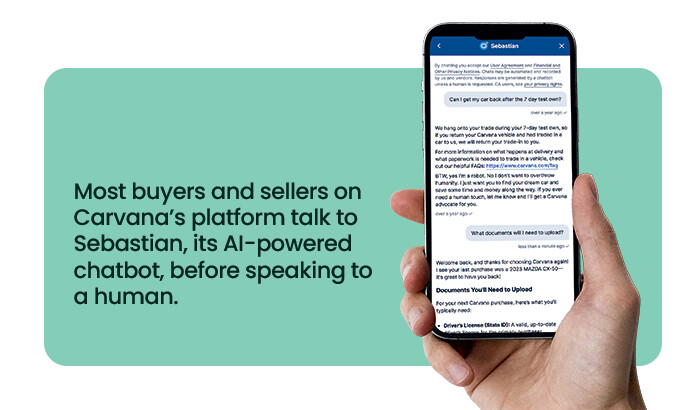
At the heart of this effort is Sebastian, Carvana’s AI-powered virtual assistant. Introduced in 2018, the proprietary chatbot at first provided customers with mostly predefined responses to their queries. Over time, with the help of machine learning, the technology became more adaptive and responsive, and today it serves as the foundation for the company’s innovative self-service model.

“I think it shows just how incredible generative AI can be,” Devkar says. The agent relies on Carvana’s own data and policies, customer-specific purchase details and prior interactions to assist customers and take a wide range of actions on their behalf. “The car that they’re interested in, their trade-in status, the customer’s particular financing terms: It’s all of those details that allow it to give high-quality, personalized answers to customer questions.”

Devkar and his team monitor the tool with a related AI system, built on Microsoft Azure, known as the Conversation Analysis Review Engine, or CARE, and use their findings to identify opportunities for improvement. “Where are we already doing well, and where could we do better? We’re looking at every single conversation Sebastian has to make sure that it’s accurate and meeting our brand standards and helping our customers in meaningful ways,” Devkar says.
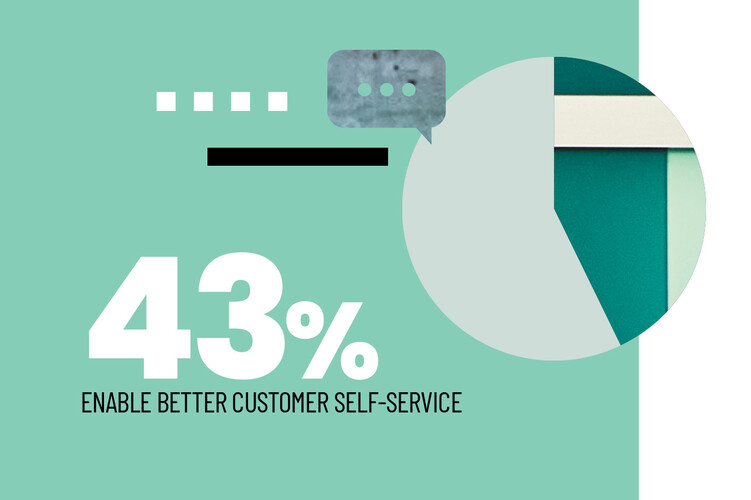
Today, more than 30% of Carvana’s car buyers don’t interact with a human customer advocate until the vehicle’s delivery or their pickup appointment. That number is over 60% for customers who are selling their cars to the company.

“And the thing about it is, we’re just getting started, because generative AI is still in its infancy,” Devkar says. He imagines a future, not far out, where Sebastian has evolved to become significantly more agentic than it is now. “It’s going to get better and better, more tailored and understanding, the more we use it and the more data we give it.”

WATCH NOW: Unlock your data potential with a solid foundation.

How Major Retail Brands Use AI to Delight Customers

You don’t have to be in the business of selling cars to recognize that generative AI can be a powerful engine for boosting customer experience.

At Ralph Lauren, an AI-powered shopping companion called Ask Ralph helps customers with styling tips and choosing outfits for any occasion. IKEA has deployed an AI assistant to provide shoppers with customized recommendations as they visualize and design their home living spaces, and at Etsy, they’re meeting buyers where they are by allowing customers to make purchases through Instant Checkout on ChatGPT. AI tools have become “commonplace helpers” for online shoppers, noted Rafe Colburn, Etsy chief product and technology officer, in a blog post announcing the integration. Etsy, he continued, was “excited to leverage AI to make it easier than ever for shoppers to discover and connect with sellers who offer items they love.” 

Perhaps the biggest driver for business IT leaders’ growing excitement about AI is the sheer volume of customer information now at their fingertips. Thanks to digitization, explains Kate Leggett, vice president and principal analyst for CRM and customer service at Forrester Research, “they have so much data they can mine, it’s practically unlimited.” Companies recognize that generative AI could be their ticket to converting this data into increased sales, she adds. “If you’re able to improve customer experience with hyperpersonalized targeting and engagement, maybe you can also keep your customers satisfied and loyal.” 

There’s been no shortage of satisfaction or loyalty at Sephora over the past year since the company launched its own customer-centric AI tools. Sephora AI Beauty Chat, available for use on the cosmetic retailer’s website and app, is designed to provide helpful and accurate product recommendations and educational information about makeup, skincare, fragrance and hair offerings. It’s also meant to serve as a guide through the discovery and purchase processes “in a way that delivers both meaningful utility for shoppers and measurable impact for the business,” says Nadine Graham, senior vice president and general manager of e-commerce at Sephora North America. 

Click the banner below to lay the data governance foundation needed for AI.


Separately, the company’s Sephora Smart Skin Scan is an AI-powered, app-based tool that analyzes a shopper’s selfie to identify skin issues and offer product recommendations directly through the user’s phone. “The scan provides an overlay showing where the concerns are on their face, and detailed information as to what each concern means,” Graham explains. From there, customers receive a “curated, four-step routine of products” that they can purchase directly from the app — a gentle push that has resulted in a completion rate of nearly 80%, she says.

Graham adds that Sephora “prides itself on being forward-thinking” around digital innovation, and notes that the company is just getting started when it comes to its plans for putting generative AI to work. “We’re excited to continue evolving to make the Sephora experience even more personalized, intuitive and seamless,” she says.

Instacart is also focused on making the consumer experience as personalized and seamless as possible, says CTO Anirban Kundu. The same-day grocery delivery and pickup service, which has worked with Google, Microsoft and others to develop a number of agentic technologies, recently developed its own suite of generative AI tools called AI Solutions. Kundu, who led those efforts, says they arose from the company’s “simple goal” of helping grocers compete and grow in an AI-first world. “Grocery is one of the most complex retail categories, with nuances in assortments, substitutions and perishables,” he explains. “It’s a perfect use case for AI and agentic commerce experiences.”

Instacart’s two key constituencies are grocery stores and consumers. Grocers told the company that they needed tools to make their businesses “more intelligent without heavy technical lift,” Kundu says. Consumers indicated they wanted customized shopping experiences that felt more intuitive, flexible and omnichannel. Instacart developed AI Solutions, which includes an AI-powered assistant for shoppers and agentic analytics capabilities for grocers, “to deliver better experiences for consumers and stronger results for retailers,” he says.

BT_CORP_Q226_Feature_Hayhurst_tertiary.jpg

The AI-enabled Cart Assistant tool, Kundu explains, layers user-specific preferences and the company’s grocery shopping expertise on top of large language models to deeply understand a customer’s intent and translate their questions into executable actions. When someone describes what they want — “meals for the week for under $80,” for example — the system maps that natural-language description to product SKUs in stores. It also instantly validates item availability, and it personalizes their shopping list based on dietary needs and past shopping preferences.

Meanwhile, AI Solutions helps Instacart’s retail partners stay ahead of evolving shopper behaviors. A tool called Store View, for instance, uses AI and computer vision to provide real-time visibility into store shelves so managers can better track inventory and reduce out-of-stock items.

In every case, Kundu notes, the AI tools that Instacart has developed started with their customer’s needs in mind. “We’re never going to use AI just for AI’s sake,” he says. “We use technology to make grocery shopping simpler, smarter and more personal, and AI is the application to drive this transformation.”

Photography by Steve Craft
Close

New Research from CDW on Workplace Friction

Learn how IT leaders are working to build a frictionless enterprise.