



Mar 20 2026
Artificial Intelligence

From Claims to Customer Insights: Generative AI Use Cases Drive Business Value in Finance

Artificial intelligence is delivering a competitive edge to financial institutions.

Data is at the core of the insurance business, where it is used to assess risk, price policies and assess claims. The central role of data positions the industry as a hotbed for innovative artificial intelligence use cases.

Verisk, a strategic data analytics and technology partner for the global insurance industry, is a prime example of a business harnessing traditional AI and generative AI (GenAI) to create new products that deliver increased operational efficiencies, productivity and profitability to its clients.

While AI can deliver great value to companies, the technology itself is not where the value is derived. Ryan Smith, CTO of Verisk Claims, a division of Verisk focused on property and casualty claim management, says the ongoing improvements being made to the company’s offerings, leveraging years of internal medical, legal and data science expertise, underline the unique value that Verisk is bringing to its customers through AI-powered solutions.

“If all you’re doing is taking the latest LLM and running your customers’ data through it and doing the output, why should someone pay you to do that?” Smith says. “Any company can do that. The key is understanding the unique value that you’re able to offer, what’s unique about your data sources, your historical data, your knowledge that’s particular to your business. Then, figure out how to harness GenAI to take that and scale it out for your customers.”

Click the banner below to learn how organizations are unlocking artificial intelligence’s potential.


Verisk’s Discovery Navigator Serves Up Insights

Verisk, based in Jersey City, N.J., supports clients with Discovery Navigator, an AI-driven solution that automates and streamlines medical record review for bodily injury claims.

“Discovery Navigator assists in reviewing medical demand packages, which are very large PDFs of medical and legal information varying in size from a few pages to more than 1,000 pages of unstructured documents, but averaging about 300 pages,” Smith says.

Discovery Navigator feeds these medical demand packages through a series of AI models that identify pertinent information such as diagnoses, dates of treatment and medical providers to transform these unwieldy packages of information into organized, searchable databases.

“The end result is that the content is searchable,” says Smith. “We break out all of the ICD-10 codes, all of the prescriptions, all of the providers, and you can get summaries based on different categories. The summarization is provided using GenAI, which also allows you to then interrogate the document.”

EXPLORE: Why is automation the key to smarter operations?

Discovery Navigator streamlines a time-intensive manual process and delivers actionable insights that enable insurance claims adjustors to make informed decisions more quickly. Ultimately, insurers can adjust, negotiate and settle claims with greater speed and accuracy. According to Smith, Verisk clients typically see a 90% reduction in time spent reviewing these medical packages.

To gain the most AI value, the company turned to Amazon Web Services and uses its Bedrock service to access a variety of AI models, including Anthropic’s Claude. Because it is a dynamic product, Discovery Navigator requires ongoing testing and updates of its underlying AI models by Verisk data scientists.

“Different processes and surgical procedures come online,” says Smith. “We have to update our models so they can identify these new procedures. It’s one thing to build the model, but another thing to maintain it. Verisk has a significant ongoing investment in Discovery Navigator.”
GenAI as a Competitive Requirement

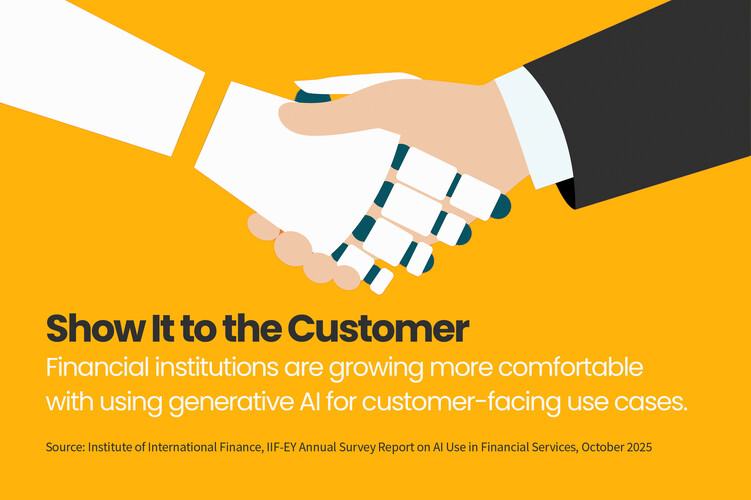
For many financial services and insurance businesses such as Verisk, the argument for adopting GenAI has moved beyond gaining efficiencies. It is being implemented into workflows with an understanding that GenAI is now a competitive requirement.

“There’s more urgency around generative AI now,” says Lisa Gately, principal analyst for Forrester. “Many leaders are asking, ‘How does this help us do something where we can show impact?’ Leaders are feeling a lot of scrutiny. With AI in place and some efficiencies gained, businesses are starting to see new revenue opportunities emerge. That creates excitement. This is the AI impact that a lot of leaders have been expecting, though it took about a year to materialize.”

While opening new revenue streams breeds excitement among business leaders, these opportunities only reveal themselves through ongoing, focused efforts to discover where AI can deliver a competitive advantage. But there are organizational workflows and operations that can deliver quick wins with AI.

GO DEEPER: Learn more about how Gemini can automate your business.

“Content campaigns for marketing are proving to be a good entry point for AI,” says Gately. “There are many ways to apply AI to improve processes like localization, translation and content repurposing. AI can set you up well for things that you’re planning to bring to market. I also see opportunities with customer support and service, HR, and finance. These functions are where people are seeing early use cases they are willing to test and move forward with.”

Companies spending time with GenAI and finding use cases for it should be on the lookout for signs that it is delivering value. With AI, efficiency gains are table stakes. There should be wider indicators of ROI.

“Look to see if quality is holding steady,” says Gately. “You’re changing the way you work and seeing gains around volume, speed and productivity. But is it consistent and still representative of your brand? For example, with financial services companies, are you still within regulatory compliance? You want to be upholding policies, even as you scale up.”

100%

The percentage of institutions planning changes in their AI investment that want to increase projects

Source: Institute of International Finance, IIF-EY Annual Survey Report on AI Use in Financial Services, October 2025

Bud Financial’s AI-Driven Customer Insights

As a provider of AI-powered B2B data intelligence platforms, Bud Financial, located in New York City, helps financial institutions understand their customers’ financial transactions, providing data-driven insights and allowing them to build services that better meet the needs of their customers.

“We provide the customer intelligence layer for banks and financial services companies by focusing on customer transactions,” says Jakub Piotrowski, vice president of product. “We built an enrichment layer using both traditional AI and generative AI that gives us a profile of each customer, and that allows banks to understand the whole portfolio of their customers."

Working on Google Cloud Platform and using Google’s Vertex AI machine learning platform, Bud Financial has developed several products, including Focus, a tool that delivers a unified view of a customer’s financial life to customer-facing bank employees. Another popular product is Enrich, which takes ambiguous transaction descriptions and adds layers of meaningful, structured information including spending categorization, merchant identification, location detection and transaction regularity.

“We’ve developed a set of language models in-house that we maintain and train,” says Piotrowski. “For example, we use our own custom word embeddings to represent tokens in transactions. We have also built and trained our own recurrent neural networks. This set of models is focused on understanding what each transaction might mean, how to categorize it and so on.”

Bud Financial’s Drive product, which takes raw transactional data and transforms it into actionable insights, also includes Drive Copilot, a GenAI chatbot interface that helps bank employees discover and act on insights for marketing, personalization, customer segmentation and customer monitoring.

Click the banner to sign up for our newsletter and receive more business IT insights.


“We’re using Gemini as the translator, as the interface between the input from the customer and multimodal agents and the language chain that we have built,” says Piotrowski. “It helps us serve that last mile of the customer-facing experience. It is tailor-made to work only with the data, which means we avoid hallucinations. Explainability is important to our clients, so no doubt can be injected into the conversation.”

As Bud Financial continues to grow and develop new applications, Piotrowski is optimistic on the growth potential for GenAI-powered financial products. “Financial institutions don’t need better CRM,” he explains. “Getting quality data is the big thing. They need to make better use of the data they already have to understand their customers. We think this is a massively underdeveloped area, and there is a lot we can do in terms of rethinking how a bank operates and making it more data-focused.”

DISCOVER: Get the tech trends impacting financial services organizations in 2026.

BankUnited Innovates Its Customer Service with SAVI

Besides applying GenAI tools to customer data to gain insights, the technology has a growing role in helping financial institutions deliver better customer service

BankUnited, a regional bank headquartered in Miami Lakes, Fla., uses GenAI to empower SAVI, its internal chatbot. Before SAVI, BankUnited employees sometimes struggled to deliver time-sensitive answers to queries from the bank’s small-business customers, resulting in lengthy call times and inconsistent answers.

Working with AWS, BankUnited developed SAVI using its Bedrock service and the Claude 2 model. SAVI serves as a policy management system, with access to more than 400 internal documents that employees can use natural language to query.

“It’s been a game changer,” says Jeiner Morales, senior vice president of data analytics and business systems for BankUnited. “We’ve gone from being reactive and spending time looking things up or waiting for answers to being proactive. Our bankers can now get quick, accurate answers right in front of them. This allows them to spend less time searching for information and more time actually listening to customers, understanding their needs and helping them make decisions.”

When queried by employees, SAVI delivers answers in under 10 seconds, with a 95% accuracy rate. BankUnited has gained wider benefits from the GenAI tool as well.

UP NEXT: Why a tech partner can guide financial services towards foward-thinking solutions.

“We’ve reduced back-office support calls by about 40%,” says Morales. “We’re also seeing improvements in customer satisfaction, employee confidence and even training outcomes. New hires feel more supported because they have this tool that can guide them. ROI isn’t just dollars, it’s about time saved, better decisions, and happier employees and customers. And by that measure, it’s been a real win.”

Having worked through the initial challenges of working with GenAI, BankUnited is now positioned to continue innovating across its 55 locations.

“This was one of our first generative AI implementations, so risk management and governance were new muscles we needed to build,” Morales says. “The technology was new, and we had to be 100% sure we were protecting customer and company data. We worked very closely with our risk and compliance teams to put guardrails in place, from data access to model validation and human review. It helped us create a framework that we now use and continue to mature for our AI initiatives.”

Photography By Kim Raff
Close

New Workspace Modernization Research from CDW

See how IT leaders are tackling workspace modernization opportunities and challenges.