



Feb 19 2026
Artificial Intelligence

How Businesses Transform Workflows and Drive Productivity With AI

From home improvement firms to manufacturers, organizations leverage artificial intelligence to lighten workers’ loads and gain a competitive advantage.

The home improvement business is wickedly competitive, with low barriers to entry, a fragmented market and customers who are wary of overpaying, willing to shop around and sometimes inclined to try doing the work themselves. In that climate, it can be difficult for companies to generate leads and set themselves apart from their rivals.

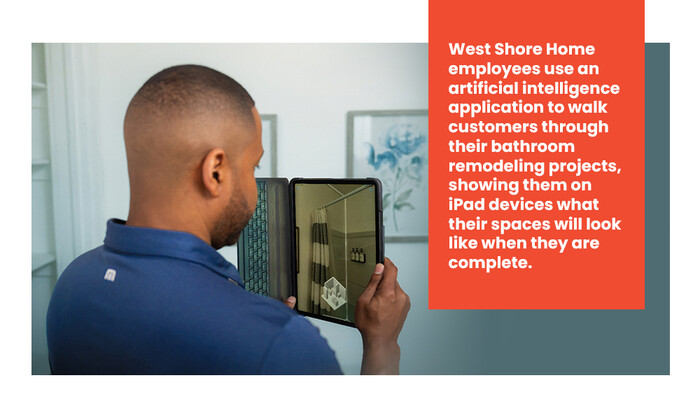
For West Shore Home, one of the nation’s fastest-growing home remodeling companies, a big part of the answer those challenges is artificial intelligence. The company, which specializes in bathrooms, windows and doors, uses AI to help customers see (literally) how their projects will turn out. Design consultants use iPad devices to take digital scans of customers’ rooms, generate detailed blueprints and explore design ideas onsite.

“It’s a beautiful thing when we can tell a homeowner exactly what the project will look like, and our design consultant can just turn the iPad to them and say, ‘All right, pick the date you want it done,’ and create that level of certainty,” says Eppie Vojt, chief data and AI officer at West Shore Home. “For us, AI is about creating more confidence with the customer and getting to that certainty sooner.”

Click on the banner below to learn how to accelerate your application modernization plans.


Operating in more than 40 locations across 21 states, the Mechanicsburg, Pa.-based company leverages AI across its platform — including for lead generation, fulfillment, scheduling and post-installation service.

Vojt says West Shore Home’s culture is uniquely focused on delivering tech-enabled innovation that delivers benefits to its customers, and computer-aided design is only one part of its AI ambitions. It has invested more than $100 million in its proprietary platform, which is overseen by Vojt and a team that includes developers, software engineers, data scientists and AI specialists. Running in a Microsoft Azure cloud, the company uses a variety of large language models to innovate across its business workflows. For example, some customer-facing use cases use OpenAI, while engineering support uses are handled with Anthropic models.

“We’re model-agnostic in our approach, so we’re constantly evaluating performance and considering the models that are available,” Vojt says. “One of the great developments in AI is that everyone adopted the same API structure. That makes it incredibly easy to switch back and forth between providers.”

READ MORE: How can businesses ensure success with application modernization?

AI Benefits Customer Engagement and Service

For many businesses, 2025 will be remembered as the year that AI began to deliver on its promise of business transformation. About 74% of AI users report that the technology has been important or very important to their firm’s competitiveness over the past year, according to a survey by the Small Business and Entrepreneurship Council.

“Customer service improvement has shown to be one of the top drivers of AI adoption in 2025,” says Karen Kerrigan, president and CEO of SBEC. “Given the increasingly competitive nature of the marketplace, they are looking to improve their customer experience. Businesses are working to get closer to customers, engaging and selling to them where they are at. AI is proving to be a great tool for supporting a better customer experience.”

AI adoption among small and medium-sized businesses has been growing, with 88% of respondents to SBEC’s survey noting they are using some kind of AI tool, compared with 75% in the organization’s 2023 survey. While the most attributed driver of AI adoption is the pursuit of efficiencies and productivity (60%), many businesses, including West Shore Home, are seeking to improve customer service and support (42%) with AI.
 

Generative AI tools have been available to businesses for about three years now, and some common successful use cases have taken shape. Not surprisingly, these use cases are focused on acquiring and serving customers. “All of these applications, including content writing and creation, email marketing automation, social media engagement, and chatbots — they all support customer service and acquisition,” Kerrigan says. “The variety of AI tools being used by businesses, there are 20 in total, reflects a great deal of experimentation and diversification across functions.”

As many businesses find success using AI, the vast majority are planning to either continue at current levels or increase investments to build on their success. In 2025, 55% of SBEC survey respondents are looking to increase spending on AI tools, while 35% plan to maintain current levels of investment. This continued and growing investment in AI indicates that businesses are seeing a good ROI. While ROI is typically measured in financial metrics, AI requires a broader array of ROI benchmarks for businesses.

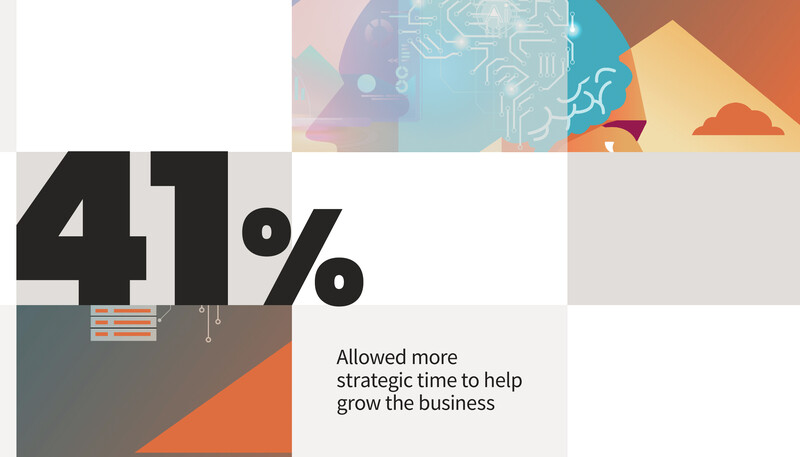
“When we ask business owners and entrepreneurs about what they are saving with AI, they say significant time and money,” says Kerrigan. “That leads to a virtuous cycle of investment or reinvestment back into the company. They’re plowing these savings and their time back into strategic growth. AI frees up business owners to actually work on the company itself, the high-level strategies. They use it to focus on higher-value work. And, of course, many channel those gains right back into technology, wage growth and new employees. So, ROI from AI can look different among businesses.”

BT_CORP_Q126_Hennick_HeavyIndustries_Image-w-Caption (1).jpg

TruckHouse Embraces AI in the Office and on the Manufacturing Floor

Matt Linder, CEO of TruckHouse, a Reno, Nev.-based, manufacturer of luxury off-road-capable expedition vehicles, is a prime example of an entrepreneur saving time and money by embracing generative AI in his business. 

“I started this business as a technician, building the campers myself,” says Linder. “Now, I’ve become an office person as we’ve grown, and the back-end office work takes more time. So, I am using every resource I have, including AI, to help get myself back on the shop floor and teaching. Because as we grow, I need to train our new people. And I also need some time to be entrepreneurial and think of what’s next — to dream the big picture.”

TruckHouse’s use of generative AI for both office functions and on the manufacturing floor began with Linder’s own experimentation with ChatGPT. He found early value in applying the Gemini AI assistant by Google to his back-office functions, going as far as to create an in-house chatbot to assist him in getting quick answers.

“We developed an agent I call the TruckHouse Business Insider,” Linder says. “It knows everything about the company and has access to all of our internal documents. So, if I need guidance on something, whether it’s financial, HR-related or legal, I can question the agent to quickly get the advice I need.”

44%

The share of organizations citing data security and privacy risks as their top artificial intelligence concern

Source: sbecouncil.org, “Small Business Check Up and Tech Use Survey,” October 2025

As he expands his company from 18 to 30 employees in 2026, Linder and his workers are too busy and simply don’t have the budget to hire a developer to build applications for the numerous use cases that arise in TruckHouse’s back-office operations and on the manufacturing floor. Linder’s leadership in bringing AI to bear on business problems influenced his young staff to do the same.

“Our enterprise resource planning technology has been growing; we have thousands of items in our bill of materials,” he says. “And my lead design engineer wanted a clearer organizational pathway or decision tree to organize it all. So, he built an HTML application and sent it out to all of us, and we all worked to develop that tree more fully. He doesn’t know how to write code, but we needed a tool, so he built it with Gemini.”

Over time, TruckHouse has developed ethos of going to AI first for a solution to a business problem. When a shop technician needed help determining the correct wiring for the vehicles being manufactured, he spent a weekend building AI application to do it.

“Each vehicle has 4,000 feet of wire with six different voltages,” says Linder. “My electrical foreman built an app that will guide the technicians through selecting the density of the wire bundle and the size of the wire loom. It’s been amazing to watch the guys run with it and find ways to save time and effort with AI.”

As TruckHouse continues to grow, Linder envisions wider applications for using generative AI, especially for repetitive, labor-intensive manufacturing processes.

“We’re excited to kind of see how robotics and AI are starting to blend,” says Linder. “We do a lot of body work and paint large, carbon fiber parts. We want to hire good craftsmen to do the work they like to do and use AI to help automate these tedious, difficult tasks. The technology is really there to empower our guys so they’re doing jobs they want to do each day when they show up for work.”

Click the banner below to read the CDW Artificial Intelligence Research Report.


AI Helps West Shore Home Deliver Certainty to Customers

Employees who succeed at delighting customers usually feel more fulfilled at work. West Shore Home employees’ SAPOS technology helps them do just that. The Scheduling at Point of Sale tools provide a clear course of action and timeline for a remodel as soon as the customer agrees to the job.

“SAPOS changes the in-home experience for our customers,” says Vojt. “It’s a clear differentiator in how we operate versus all of our competitors. It lets our employees communicate to the customer exactly when we’re going to have the materials and when we’ll have the right employee available for the remodel. The confidence this creates for the consumer is really powerful.”

West Shore Home continues to seek out ways to improve the experience of its customers, pursuing a business vision that delivers a greater degree of certainty thanks to generative AI.

“The notion of transforming the buying experience is incredibly compelling, and we expect that soon, we’ll move toward something that feels more like e-commerce,” says Vojt. “The customer can capture the current state and supply us with that information. Then, from a series of provided pictures, we can deliver a robust online experience for them that offers a sense of what the project could look like and what it’s going to cost.”

Photography by jonathan thorpe
Close

New Workspace Modernization Research from CDW

See how IT leaders are tackling workspace modernization opportunities and challenges.