Mar 23 2026
Artificial Intelligence

NVIDIA GTC 2026: Retail Sees Great Potential With Physical AI and Operational Improvements

The dawn of AI means that retailers are evaluating the technology to unlock customer insights, improve efficiencies and enhance experiences.

For a long time, the conversation in retail was around e-commerce replacing or complementing physical retail. But AI is renewing and invigorating a focus on the in-store and in-person experience in interesting ways.

Let’s start with the grocery store shopping cart. Instacart, best known for its personal grocery shopping and ordering business, acquired Caper AI back in 2023, which had a smart cart business. At NVIDIA GTC 2026, David McIntosh, chief connected stores officer for Instacart, showed how Instacart has supercharged the Caper Carts with AI technology from NVIDIA and explained why the company believes the real potential for AI lies in maximizing and optimizing retail’s most valuable asset: the in-store experience.

“I think the biggest impact that AI is going to have on retail is in the store,” McIntosh said during his GTC session, entitled “Reinvent Omnichannel Retail With Physical AI: Connect Stores From Edge to Cloud.”

“What retailers have that none of the LLM [large language model] hyperscalers have is in-store. They have physical stores. They have customers going into their stores, and so the way we think about it is, it’s a strategic imperative for retailers in this space to build that understanding of the store to build that understanding of the customers,” he added.

During his presentation, McIntosh went into detail about how the souped-up Caper Carts that the company has deployed in over 100 grocery stores — with partners such as Kroger, Wegmans and ShopRite — are using AI to transform the grocery store experience into one that is frictionless, delightful and innovative for shoppers. 
 

Caper Carts sensor technology

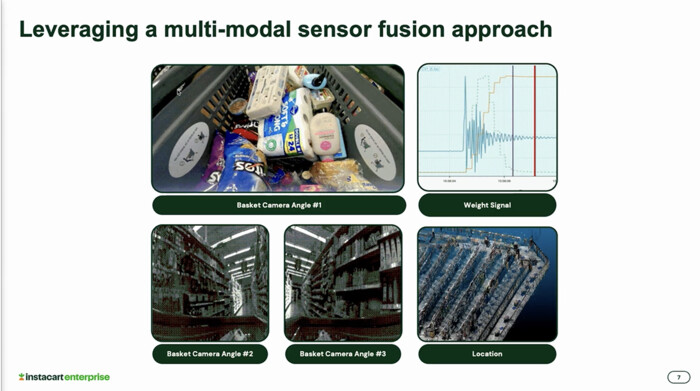
“It’s a smart shopping cart, equipped with a digital screen, camera sensors, location sensors, and a weights and measures scale, and an NVIDIA Jetson board in every one of these smart shopping carts that we’re putting in our retailer stores,” he said.

The shopping cart, which is at the center of the store experience for most grocery store shoppers, is transformed from an inanimate, unresponsive object into a smart, connected and responsive tool that allows the retailer to engage with the shopper.

“The magic of the consumer experience is that customers are engaged for 30-plus minutes while shopping,” said McIntosh. “The majority of users log in with loyalty, so they get personalized deals, discounts on the screen, based on location, because of the location sensors.”

And while McIntosh believes in the physical store and in-store experience and competitive advantages for retailers, he’s not neglecting the digital side as the Caper Carts enable omnichannel experiences as well.

“We’re unifying the online and in-store experience with Caper. You can take the shopping list you’ve built online, or it will remind you before you check out to buy things that you forgot,” he said.
 

Shopify Uses AI to Give Small Retailers Scalable Personalization

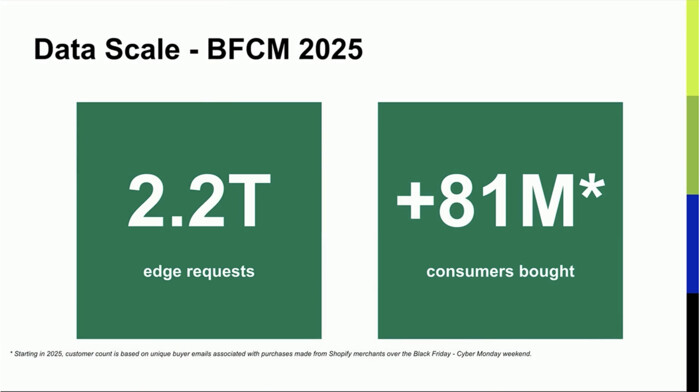
As a platform for online retailers, Shopify is in the business of ensuring that other company’s shopping experiences are great. While they provide the building blocks needed to run an online store, Shopify is laser focused on using AI to boost conversions, transactions and product recommendations. The company is aiming to improve the experience for both merchants and shoppers alike — at scale — having served 2.2 trillion edge requests and 81 million consumers from Black Friday through Cyber Monday in 2025.

Black Friday Cyber Monday 2025 Shopify data results

“Shopify merchants represent more than 12% of U.S. market share,” said Diego Ardila, senior staff machine learning engineer at Shopify, during his GTC session titled “Building Shopify’s Commerce Foundation Models.”

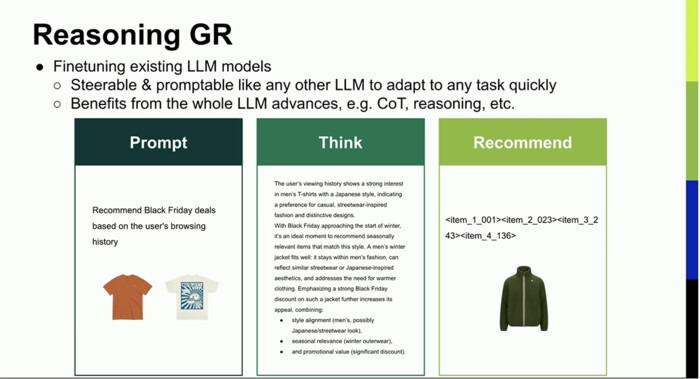
Product recommendations are one area where Shopify is using NVIDIA Compute Unified Device Architecture (CUDA) kernels and AI inference to improve experiences for merchants and customers. Their AI recommendations, called Generative Recommendations (GR), are similar to other recommendations that are common to the online shopping experience, but Shopify believes that AI and context can make the suggestions more relevant.

“We can fine-tune the LLM to reason about the recommendations we are making,” said Ardila. “Instead of just recommending a product to a buyer, we can explain why that product might be interesting to them.”

Reasoning GR Shopify

While personalized shopping is the norm for large online retailers, it can often be expensive to deploy. But Shopify is using AI to bring personalized recommendations to small online retailers, which helps to level the playing field.

Yum! Brands Uses AI to Turn In-Person Experiences Into Company Insights

As the owner and operator of beloved quick-service restaurant brands KFC, Taco Bell, Pizza Hut and Habit Burger & Grill, Yum! Brands is responsible for $68 billion in system sales across 63,000 restaurants in 155 countries and territories.

That scale means that at any given time, there’s an incredible amount that must go right. And it means that any experiments and improvements that the company implements need to be done with caution and care — especially because they operate with a franchise model and have over 1,500 franchisees to answer to.

“When you’ve got 100 million transactions a day, that scaling speed is exciting, but it also means that failure at machine speed is incredibly risky. It can kill you very, very, quickly,” said Cameron Davies, chief data officer for Yum! Brands, during his GTC 2026 session “Scaling AI Agents Globally Across Brands, Use Cases, and Restaurants.”

The stakes of getting it wrong can ripple across the entire brand. That’s why he doesn’t take the typical proof-of-concept approach to implementing AI within his company. His focus is on getting better at gathering data across the company’s stores so that it can learn and improve in ways that boost customer, employee or franchisee satisfaction. The company uses a mix of NVIDIA AI tools to do this, including NVIDIA NeMo, NVIDIA NIM, and NVIDIA AI Enterprise.

“The more surfaces we own, the more outcome data we get. The more outcome data we get, the better the experience and the better our ROI,” said Davies. “The better our AI, the better those experiences on those surfaces.”

One area where Davies and Yum! learned something from using AI to analyze their data in an unexpected way is the impact that AI recorded drive-thru messages had on employee satisfaction. The expected metric to evaluate would have been to see if the AI-upsell improved sales for consumers. Instead, they found that the AI audio actually improved employee satisfaction, since it alleviated them of a burden. And improving employee satisfaction has a direction connection to reducing employee turnover, which is a metric that franchisees care about.

“The one consistent thing you saw was the employee satisfaction, because you took the burden off of them,” said Davies. “Reducing that [employee] turnover by an order of magnitude of 2 to 3 times is huge.”

What these three different retail leaders and their varying experiments and innovations show is that AI is shifting how companies think about customers, assets and experiences, in ways that are pushing the bounds of what was thought possible. Expect to see continued investments as AI matures and continues its integration into the retail industry.

Keep this page bookmarked for articles from the NVIDIA GTC 2026.

Ricky Ribeiro
Close

New Workspace Modernization Research from CDW

See how IT leaders are tackling workspace modernization opportunities and challenges.