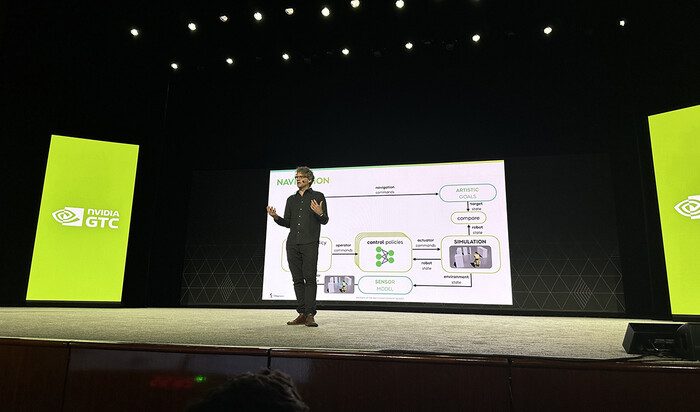
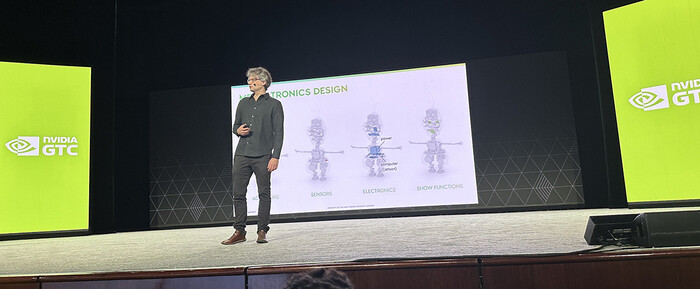
Moritz Bächer, lab director of Disney Research, shows off the AI and robotics technology that underpins its soon to be released robo-Olaf in its theme parks at NVIDIA GTC 2026.
NVIDIA GTC 2026: Humanoid Robotics Technology Brings Imagination and Innovation Together
Disney is poised to supercharge the immersive nature of its theme parks experience with a walking, talking, blinking robotic recreation of its iconic character Olaf.
Ricky oversees and leads the editorial team for BizTech magazine. He's a writer, technology enthusiast, superhero lover and eternally curious.
There’s been a surprise breakout star at NVIDIA’s GTC 2026 conference. While the conference is most definitely geared toward adults, a robotic replica of Olaf from Disney’s Frozen franchise has routinely stolen the show, leading to large applause and warm laughter from the mostly middle-aged crowd.
Robo-Olaf made his first appearance at GTC during NVIDIA CEO Jensen Huang’s keynote presentation. Huang invited Olaf onstage as a surprise at the end of his presentation, where he confirmed that Olaf’s brain was powered by NVIDIA Jetson and NVIDIA Omniverse. The company describes the technologies respectively as the “leading platform for edge AI and robotics” and “a collection of libraries and microservices for developing physical AI applications, such as industrial digital twins and robotics simulation.”
“I gave you your computer, Jetson,” said Huang.
“What’s that?” asked Olaf.
“Well, it’s in your tummy. And you learned how to walk inside of Omniverse,” said Huang.
Are Jensen Huang and RobOlaf the next buddy series in the making? Their chemistry during the #NVIDIAGTC Keynote certainly piqued my interest in seeing the two together more! pic.twitter.com/0ojESnggZZ
But Huang didn’t stop at the product placement. He made plain to the audience the potential business implications of Disney making robotic versions of its most iconic characters.
“Could you imagine this? The future of Disneyland? All these robots, all these characters wandering around?” Huang asked the audience.
That won’t be hypothetical for much longer. Olaf will be tottering around Disneyland Paris at the end of March, the company announced after the robot’s debut at NVIDIA GTC.
And, as the company teased, Olaf is just the beginning: “The speed at which we’re able to create new characters — and get them in front of our guests — is unprecedented. We are working to bring more emotive, expressive, and surprising characters to guests at our parks and ships around the world,” the company stated in its press release.
With AI, Disney Uses Robotics to Make Storytelling Magic Real
It’s no secret that Disney’s theme parks are big business. Last fiscal year, the Disney Experiences division (which includes the parks, cruises and resorts businesses) posted revenues of more than $36 billion. To grow that business, Disney must continue to surprise and delight its customers.
Increasingly, the theme parks have used technology to make the Disney experience more immersive. Allowing guests to interact with a robotic version of their favorite characters — rather than a human in a costume — enhances that interaction.
And behind that experience is a monumental amount of computing, engineering and artificial intelligence.
In a breakout session at GTC titled, “Disney’s Olaf: From the Screen to Reality Via Physical AI,” Moritz Bächer, lab director of Disney Research, offered attendees a peek behind the curtain of the technology underlying Olaf and the BDX droids that debuted almost year ago in the “Star Wars: Galaxy’s Edge” themed area of Disney Hollywood Studios in Florida.
Describing Disney’s ambitions with robotics in a company blog post last year, Kyle Laughlin, senior vice president of research and development for Walt Disney Imagineering, said, “At Disney, we’re not building robots for factories or fulfillment centers — we’re building robots that make you feel something. That’s a very different challenge. We’re bringing emotional intelligence into the field of robotics, and we’re doing it at scale.”
That emotional intelligence is mapped out in Disney’s robotics architecture map as part of the company’s “artistic goals.” Robotics in general relies on a series of commands and policies to train and operate the robot, and Disney uses technology, animation, engineering and AI to optimize and refine the robotics performances so that they match the emotional expectations of its theme parks’ guests in a way that feels authentic to the artistic goals of the intellectual property it is recreating.
“For us it’s not just about functional autonomy, it’s about believable autonomy. You want to believe that this is a character onstage and not just functionally going from A to B,” said Bächer.
Composed of actuators, sensors, cameras and other electronics, robo-Olaf is the culmination of a simulator that Disney has been engineering and working on for some time, called Kamino. Bächer explained that the company chose that name for the simulator based on the Star Wars planet whose inhabitants were known for cloning.
As it prepares to roll out robo-Olaf in its theme parks, falling is one of the problems that Disney has solved for. The robots are likely to fall as they wander around the park, but Disney doesn’t consider that a failure — it’s just a scenario that needs to be planned for, and the team has come up with stylized ways for the robots to fall that make it look like it’s all part of the fun.
“Falling is just part of the functionality we need to cover, and it’s not a failure,” said Bächer.
Other minor details the engineering team has sweated through is softening the heaviness of robo-Olaf’s steps so they’re more like those of a magical snowman and not a hefty hunk of metal. Another is managing the heat generated by the robot turning and moving its head repeatedly.
“Olaf literally learns to manage its own heat,” Bächer said.
All eyes will be on the launch of robo-Olaf at Disneyland Paris. Should it prove successful in delighting park visitors, it will add a new dimension to the theme park experience for many fans — precisely what Disney hopes for as it continues to invest heavily in physical AI.
“You, as a guest, can co-direct the story,” said Bächer with excitement.
Keep this page bookmarked for articles from the NVIDIA GTC 2026.